
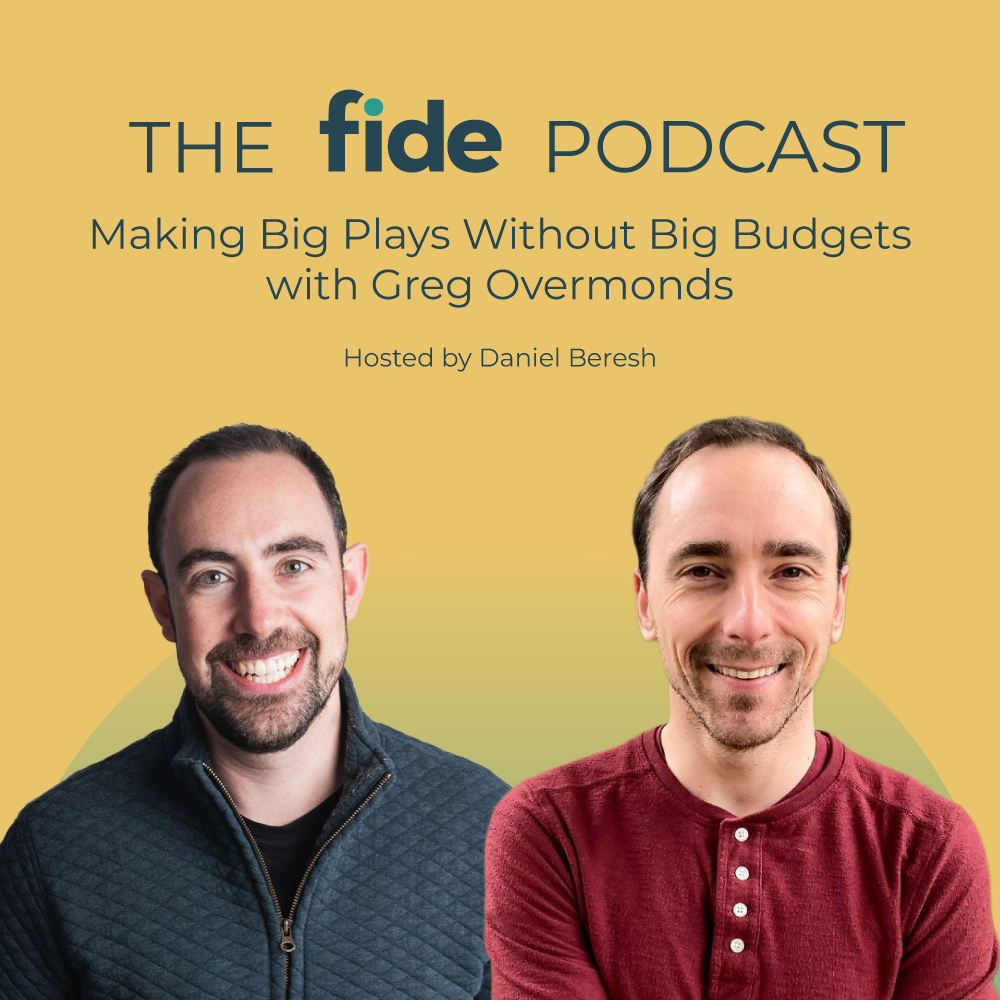
Big budgets can buy attention, but they are not the only way to earn it. In this episode, Dan speaks with Greg Overmonds, VP of Marketing at SWTCH, about how challenger brands can create an outsized presence by staying laser-focused on the right audience, resisting shiny-object tactics and investing in the ideas most likely to make an impact.
Listen to how SWTCH combines proven B2B marketing fundamentals with new AI tools, including a series of bold, fully AI-generated commercials designed to compete for attention alongside much larger brands. Find out why a strong story still matters more than the technology, how marketers can take creative risks without compromising their brand and why AI should create more room for strategy, not replace genuine customer understanding.
Dan Beresh: [00:00:00] Hey, welcome back to the Fide Podcast. I'm Dan Beresh, founder of Fide, and this is the podcast about enterprise B2B marketing, about how to go to market, uh, in a world that's just changing so quickly. And I'm so excited to have Greg Overmonds on the podcast today, and Greg is from a medium-sized or- organization.
I'm so excited to, Greg, have you talk a little bit about what that's like to, you know, work with sometimes smaller budgets and, and, and how do we make things work when, you know, we don't have necessarily the, the, the number of resources, uh, [00:00:30] that, that y- you know, are, are typical for a larger organization. I think we're seeing sometimes this happening, uh, i- in the market these days, especially with all the volatility.
Um, so it's gonna be really interesting to talk about that. And Greg, we've also produced this incredible AI video together, 100% AI front to back, and, uh, I, I think it's gonna be really interesting to think about, you know, how that fits into your marketing mix and, um, and how that project went. So Greg, so happy to have you here and, uh, and thanks very much for, uh, for coming on the podcast.
Greg Overmonds: Yeah. Thanks for having me here. Uh, looking forward to diving into it.
Dan Beresh: So Greg, you work [00:01:00] for SWTCH Energy. Tell us a little bit about, uh, you're the VP of Marketing, you know, your role and, and, and kinda what does, what does SWTCH do for those people who aren't familiar?
Greg Overmonds: Yeah. So, so SWTCH is, um, it's an EV charging company.
Um, we manage chargers all across North America. We're headquartered in, in Toronto. Um, and we're, you know, one of the pioneers. We've been doing this for 10 years. Uh, and personally, I've been here for four years, uh, leading marketing. And for us, it's about managing chargers in condos, apartments, um, from Scotia Plaza in Downtown Toronto to, you know, [00:01:30] condo buildings all across North America.
Um, our job is to make sure that they work, and we're bringing innovation to make them scale to, uh, ensure everyone who wants an EV can charge at home wherever they live.
Dan Beresh: So Greg, when we had talked about, you know, coming on the podcast together, you mentioned to me that, uh, you know, your role really is to make a huge impact with a limited amount of, of resource, as I'm sure is the case with a number of, you know, medium-sized businesses out there, right?
You d- you're not gonna have [00:02:00] unlimited budget, and you never will. Uh, and I was really impressed with some of the ways that you are, uh, kind of attacking this challenge and making sure that SWTCH has an outsized impact compared to its competitors. Tell me a little bit more about what's your, what's your approach?
How do you, uh, h- how do you make that happen? How do you create an outsized impact as a marketer?
Greg Overmonds: Yeah, I think it goes down to the core fundamentals of understanding who we are, and we at, in essence, are a challenger brand. We are trying to, uh, take down the incumbents, people who have, you know, hundreds, hundreds of employees, thousands of employees, [00:02:30] and multimillion-dollar marketing budgets.
Our job is, is to win. Um, and there's several ways to do that, but from a marketing perspective, we need to look and be as big as we can so that when these large firms are looking at large-scale rollouts of EV chargers, uh, we wanna make sure we're, we're going toe-to-toe, uh, with those incumbents and those leaders.
And so to do that requires a much more of a Swiss Army knife than a bazooka when, when you're having a marketing approach, because ultimately, uh, we just don't have, I don't have a $20 million marketing budget in order to, to do all the [00:03:00] big things and all the things that you'd wanna do. So instead, we have to be laser-focused, and that I think is the core of a challenger brand as a, trying to be as big as you can, but being really focused on who your ICP is and making sure that those people can get that trust and perception that you are toe-to-toe with the giants.
Dan Beresh: As a, as opposed to Not knowing as well who your IF- ICP is, not really defining it as well as you could, sort of, you know, going out with more of a throw everything at the wall and sort of kind of see what sticks sort of approach. Is that, is that it?
Greg Overmonds: Totally. Like, we [00:03:30] have technology that's designed for, you know, condos and apartments that have old electrical infrastructure that wanna see how you would put 30 or 40 chargers in there.
So for us, we know that our technology is well-suited for a particular type of built environment property, condos, apartments, uh, and commercial. And so for us, it's, it's laser-focused. It's focusing all of our budget, our small, mighty budget, on that sector for the most part, so that when a large, you know, uh, multifamily operator, like a Greystar or a FirstService Residential, as [00:04:00] they're looking through their various channels, they keep seeing SWTCH.
They keep seeing us because, you know, now the LLMs are pulling us as the de facto leader in multifamily EV charging, right? Really honing all of those different channels, from SEO, uh, to now, you know, our geo strategy with LLMs, to making sure that we're showing up in the right events, the right conferences.
But we are truly focusing our efforts so that we're hitting them five, six, 10 times. And from their perspective, they just see us being large. But it's not taking the large budget, because to your point, we're able to [00:04:30] focus those monies, uh, where it's most valuable for us.
Dan Beresh: Something I keep hearing from marketers with bigger budgets is this consistent frustration with tactics that don't necessarily roll up to a larger strategy, because you've got, you know, people coming in and asking for things here, there, and everywhere.
And it seems to me that, you know, we're in an interesting moment, aren't we? Because more tools and more channels are more accessible than they've ever been before. And yet, what I'm hearing you say is it's actually [00:05:00] about really less is more. And I think that that's something that I would take away and I would say could apply to, you know, anyone across any B2B marketing role, is there's so many shiny objects out there.
Greg Overmonds: Yes.
Dan Beresh: And you have to be laser-focused with your strategy to make sure that you're putting, no matter how many dollars you have, you're just gonna maximize that investment by ensuring that everything rolls up to that, that larger strategy.
Greg Overmonds: And that's the exact same approach when it comes to the adoption of AI, right?
Like, there are, as you say, so many tools. Every day there's another AI tool [00:05:30] that's designed to help productivity or efficiency or reach the right market or understand data better. But ultimately, like, you can get lost in all of the AI, you know, stack that you wanna add in. And to your point, like, what is laser-focused that's actually gonna help me reach my objectives and h- you know, be more engaged or ga- grab more interest or educate better for the target that I want?
There are some wonderful AI tools that we adopt, but, you know, I can easily get overwhelmed when I see people who have these posts that say like, "Oh, I've transformed my har- my whole marketing stack, fully AI top to [00:06:00] bottom with agents that talk to agents who talk to agents." It's like, yeah, it's like, wow, are we missing the boat?
But then when I actually take a breath and look to see, like, what's the actual work that needs to get done, what is the actual outcomes that we want from these tools- i- they just, it, that, that doesn't necessarily apply to us, and that's okay, right? And that's okay for marketers to realize that, like, there's a lot of tools that you could spend all day and all night trying to integrate and trying to get optimization, but at the end of the day, you may just run around, uh, with your head cut off trying to integrate tools when it's actually not working towards your strategy.[00:06:30]
Dan Beresh: And there's so many tools, to your point. Uh, tell us a little more about that. I mean, you have, I think, a really great way of seeing the whole field of tools and saying, "No, I am going to say yes to just a few things." And I, I think, you know, saying yes is to, uh, anything in life, is really saying yes, to your point, to something that is gonna take your time, is gonna take your energy, and is gonna take you away from other things.
So how do you, how do you do that? What's your, what's your strategy? W- how do you look at the, the, the field of tools, the field of tactics, the [00:07:00] possibilities and say- I'm gonna, what, I'm gonna say no to what, 90% of this? What's-- How do you do that?
Greg Overmonds: Yeah, it's, I think it's about staying core to, to who you are and what your foundations of, of a marketing mix and a marketing plan are, and just complementing it instead of tearing it all down.
So for a good example, like some of the classic tried and tested too strategies, things like retargeting. Like, it's unsexy now because the idea of pixeling your site, uh, and, and doing retargeting across many different, you know, pillars and platforms and ways to, to essentially follow along your, your people [00:07:30] through a journey, you know, that was 15 years ago.
But it is by far the most effective tool still today versus all the AI tools out there, and I am flabbergasted when I find out more marketers aren't leveraging the retargeting p- pool and their pixel in lots of places. Um, it baffles me. And they're chasing new data streams or, like new insights of, like who to chase after.
Well, why are you chasing after cold when you haven't really even harnessed the people that have shown intent to visit you on your website? And so for us, so [00:08:00] much of our effort goes into taking those people through an insane journey, uh, like a 90-day journey. It is, it is education, it is content, it is video, which we'll get to, right?
It is, uh, it is video in several different formats. It is making sure that when they are doing all the things in their life, they keep seeing SWTCH, which only reinforces the fact that we look really big to them. We don't need to look big to everybody. That is way too expensive. But we can do a very good job with the tools available that were around 10 years ago to continue [00:08:30] doing that work.
Yes, AI has made that work more efficient because we're using better tools to help us write faster, uh, and iterate on content and iterate on ideas so that we can have more delightful content throughout the whole journey from day zero hitting our site, for example, to day 90, right? We're using AI video as a way to continually bring new engaging content to hit new different pillars and new channels, be it CTV, connected television, uh, and YouTube video that unfortunately our budgets wouldn't allow us to do the [00:09:00] same type of, uh, creativity and, and we'll talk about that shortly.
But so there are, there are various AI tools that are along that we've injected into the process. Data, right? Like we've got lots of data that by leveraging AI to bring insights from that data, we can create really cool, nice infographics and messaging, uh, throughout the journey to help bring that data side to the k- the education and the customer side.
And so all these, these, these small tools fit in different ways, but it, the core stays the same. The core strategy has been the same since the beginning 'cause it's worked, and it's the playbook [00:09:30] that has seen great success. We're just able to scale that a bit faster in, in 2026.
Dan Beresh: Yeah, I love what you're saying, and it reminds me of a discussion I had with Daphne Luchtenberg on, a couple episodes ago on the podcast, where she was saying B2B marketing has not fundamentally changed, and I couldn't agree more.
I think, you know, what, what is our job at the end of the day, Greg? It's to figure out who our ICP is, figure out who the people are, who we wanna reach, and to reach them in an interesting and memorable way so that when they actually are ready to buy, that they're gonna remember our brand, right? Like, it, it is- 100%
in my view, not more complicated than that, and [00:10:00] yet I scroll my LinkedIn and everyone says, "Marketing is dead. You know, SEO is dead. This is dead. That..." And we live in this world where we're, I think, prompted by the algorithms of social media to say these w- outlandish things and to, to almost Go, how do I put it, Greg?
Y- y- y- you're in a world where, where people are motivated to tell you that things are wrong and broken, that you need to change, and that everything needs to completely be rebuilt from the ground up. [00:10:30] So I love what you're saying- Mm-hmm ... that yes, there are new tools, yes, there are new methods, but fundamentally, things have not really changed.
And, and using an unsexy method from 10 years ago maybe is the key to unlocking a bunch of new business because everyone else is chasing these shiny objects whose, you know, board members and CEOs are saying, "How are we using AI in marketing?" And, you know, and, and, and I'm sure that everyone in marketing right now is under a huge amount of pressure to integrate AI.
But integrating AI for the sake of it is, it's silly.
Greg Overmonds: Totally. And I think the one thing when I always look at those, [00:11:00] like, X is dead posts, which are very common, to your point, is that, like, sure, I think the caveat is that, like, the way you used to do it six years ago may not still be effective, but the channel can still be effective.
Email is not going away. Sure, but maybe the way that you did email six, six years ago needs to change because people are getting so many emails these days. How do you stand out? How do you truly build community through the channel versus just, like, spraying and praying, and that was more effective because there were m- like, there were fewer emails in [00:11:30] inboxes.
Now I'm getting 50 plus of outbound AI, quote unquote, "personalization" emails that just, like, pull something from my LinkedIn. It's like, that's, that's not effective. So people, you know, just easy to say, you know, email marketing is dead, or SEO is dead. All these things have just a way you have to evolve them with the fact that, yeah, there are more tools, there's more noise, there's...
And so to the core, right, you need to either educate, you need to inspire, uh, you need to make them remember the interaction in some way, shape, or form. [00:12:00] And it was, it's just, it is harder now. There's just so much of it. And so that doesn't mean it's, it's not possible. You just have to be more creative. You gotta be more innovative.
You gotta truly understand the buyer, what makes them tick, because you only have a shot, maybe a couple shots to really gather them and, and bring them into your experience, into your funnel, into your website, whatever action you want to take, have them take. Yeah, it, it's, it's, it's harder.
Dan Beresh: It is absolutely harder, yeah.
And that's, I'm glad you brought that up. It, it's not like the world is exactly the same as it was 20 years ago. It's not like- No ... the, the way in which we have to do our job is the same. [00:12:30] Um, fundamentally, we, we, we just have to approach a, a more difficult problem with new tools in a, in, in kind of a different way.
But remembering that at the end of the day, uh, it, it is just about educating and, and, and captivating and really making sure that you are that- Uh, that company that, that remains top of mind by the time that, uh, that buyer decides to at least make a short list. And we'll- Yeah ... let's talk about that later, but I think one of the really interesting ways that you can use AI and, and use the new tools, uh, is, is to create video.
[00:13:00] And one thing that we've been doing at Fide is creating AI video from the ground up, meaning, you know, everything we do has an AI component to it. It doesn't mean that I enter a prompt and I'm, you know, i- immediately presented with an eight-minute video that's flawless, and I've got cutdowns for LinkedIn and paid media, you know, ads and things like that.
But it, it is a brand-new way to be creative. And, um, so we've just completed this really fun project with you, and I, I mean, it was so interesting to have the back and forth [00:13:30] and the kinda new process of, uh, o- of this AI video creation. So Greg, I mean- I don't mean to put you on the spot here, but do you wanna give us a little bit of a background on kinda tell me about how this project started for you?
What, what drove it? Why did you wanna, uh, to get into doing AI video as part of your marketing mix?
Greg Overmonds: This was started two years ago when, um, as SWTCH is a, you know, a B2B company that doesn't, um... The product isn't particularly, um, sexy or, you know. It's, it's chargers, um, it's glorified plugs, it's, it's wires and poles.
And so for [00:14:00] us, right, like most of our, our messaging and communication is pretty standard. But for us, how do we break through that noise? And one idea I had two years ago was let's be a bit, a bit humorous, right? Like, how do we, how do we tell, how do we connect with people in a way? Because there's so many problems with EV chargers that people run into when they're installed poorly, or they're done poorly, or they made the wrong choices.
And so we, we talk through those customers day in, day out. So the thought was, you know, what if we, we, we leverage that and, and, and show people the problems that could exist if you don't choose SWTCH, [00:14:30] if you use a, a poor provider or a low-budget provider or somebody else. And so, uh, I had this commercial series spun up in my head where we'd showcase, all right, this is a problem if you don't have a lo- loitering policy or, you know.
And then, and then it's the, "Oh, with SWTCH you can do, you can do this in, in X and Y and Z." And so I came up with like six or seven ideas that essentially talked about our different value propositions, and I wrote it all on a Google Doc, and then I realized, well, how do I bring this to life? Well, three years ago, to be able to [00:15:00] bring the creativity and the fun out of it, it would've cost, uh, you know, each one of those videos would've cost like exorbitant amounts of money.
You know, it would've been lots of CGI and animation, like lots of stuff that with our budgets we just, we didn't have, didn't have it. Nor could we see the, the whimsicalness of it, the, the funness of it because it was, it was outside of the scope of, you know, the human landscape. And so I g- basically had to shelf it until, you know, Google V- uh, was it VO, VO2 or whatever?
VO3. The, the VO3 was like the first real [00:15:30] moment, like 12, 18 months ago- Mm-hmm ... that actually brought that eight-second AI video. You prompt it, the video was like, oh, this isn't actually too bad. It was like, it was the spark in that moment to be like, hey, maybe there is a world in the short future where, where these whimsical, creative, you know, commercial ideas could come to life.
Uh, and so, so VO3, you know, tried and, um, you know, did a little bit, uh, and then I realized it got a little bit better. Uh, and then I started reaching out to, to different agencies, say, "Who wants to partner with me on this? Who wants to actually, you know, jump on the [00:16:00] boat and, and work alongside to journey through the innovation of the technology as well as understand how to leverage those tools?"
And, and, you know, I came to Dan and, and he was, yeah- ex-exuberantly excited to, to, to journey alongside. We didn't know where it was gonna go, but I am so thankful that you and the team decided to, uh, to, to give this crazy idea a go. Because yeah, now, what is it? 12 months later, you know, fast-forward, we've done three of these.
You know, we've built three AI videos, fully AI, um, that [00:16:30] tell three of the, I think I've got six in the series, um, these three really neat moments that could go wrong if you didn't choose SWTCH, and, and showcasing, you know, what, what could go right if you choose SWTCH. And ultimately, I think they're great.
Like, I think they, they break the mold in which a lot of B2B marketing kinda always lives in, is like safe. Safe, you know, I can ... I, I have a 30-second video which has got B-roll and, like, a nice narrative, and like, you know, it's nice, but when you leave it, [00:17:00] you don't, it's not memorable. And that's okay. Not everything needs to, like, slap you in the face memorable.
But I thought let's, let's go there. Let's be a little bolder than what we, we traditionally do. And so that was the, the, the, the start of this project. Um, and yeah, I c- I can happy say, like, it's, it's doing that job. It's, uh, the engagement is great. It's better than any engagement that we've had on any other videos.
It's beating benchmarks. People are staying longer on the videos. Um, and it's given us new content to bring to that [00:17:30] retargeting drip funnel that is in new channels that we can explore, like connected TV. So they're watching their, their, you know, their latest Netflix show, and halfway through, you know, there, there's a commercial or two, you know, SWTCH's commercial's getting right in there.
And so it's toe-to-toe right beside a Nike ad or, you know, um, a big brand ad. And so you get that connectivity of like, oh wow, SWTCH is big, and it looks good. And so the two combination between not only looks good beside a big brand, and it's [00:18:00] telling a good story. And I think that's a big thing about AI video and people's misperceptions about it, is that they feel like, oh, it's AI video.
Whenever you see them, they're like, they're garbage. They're just, like, basic. They clearly look AI. And I think the big thing that you need to realize is that those ones rarely have story. They're just built video for the sake of video. But if you actually have a good story that's compelling, right, AI, you know, is, is quote-unquote okay.
It actually can bring you to a new world that actually is more delightful [00:18:30] because of the, the bounds that it can take you. But it all comes down to having a really good story. And if you don't have it, um, then that's where I think the biggest pain point and, and the hurdle that most people fall- Of course
when they try to do AI video.
Dan Beresh: This is just the s- Well, and it, it's a tool to create it, right? It, it, it's a- Totally ... it's, you're not, you take, uh, bad data in is bad output out in any situation. And, um, not to reduce creative to data, but that's the reality is if you have a bad story that's going in, then you're just, you're, you know, you're ne- you're never gonna get to, to [00:19:00] really captivate.
Greg, you know, from my perspective, it's funny because you talk about VO3 coming out. We were at Google Cloud Next when they launched VO3, doing client work, showing marketing that we had done for, uh, one of our clients. And so we watched our video on the keynote stage, had it fade out, and then, uh, all these folks from Google Cloud come out and start talking about the, the various technology that's, um, starting to come out and, and, and one of them was, was VO3.
And I recall thinking, "My God, this is [00:19:30] really gonna change things." Because it really was that moment where AI video started to become real, where you didn't get six-finger hands, where you didn't get this weird forced perspective. Um, and so, uh, what a, what a great journey it's been to be on this, this with you and, and to kind of be creating alongside you.
Uh, and such an interesting, uh, project because of the way in which we've kind of had to, uh, to, to do it, right? So for those of you who are listening who aren't familiar with AI video and AI creative and the [00:20:00] way that, you know, it works, it really differs in the sense that you have a similar creative pipeline in terms of that idea going into, you know, we presented storyboards to you, Greg, right?
Same as you would for a, a- any kind of actual live shoot. But the storyboards are actually the full generated images that are then gonna become the videos, right? We're, we're generating the video based on the kind of still image. So you're able to look at those and say, "This is exactly what I'm gonna see [00:20:30] in the final product."
Um, and I think make some more, you know, judgment calls based on that. But then on the flip side, because AI has that built-in sense of randomness, right? When you look at it, you say, okay, I mean, for example, we created a, a video where the concept, you know, was a wrestler versus a woman in, who's off to yoga class, and they're both fighting over this charger.
Um, if you had said, "Hey, I, you know, I really want the, the trees in the background to be palm trees," we SWTCH it to palm trees, give it a little, you know, [00:21:00] prompt, say SWTCH it up. Suddenly the woman in, in yoga outfit is in a completely different color. And so the, it's an interesting sort of creative trade-off.
And one of the things that I think was kind of an interesting challenge, uh, if you don't mind me saying, I mean, t-tell me about this. It's you have to respect the boundaries of your brand and the kinds of things that your clients are going to expect. Because when people watch an AI video, they're not saying, "Oh, this is AI, so therefore I accept that it's in a completely different environment and I'm-- don't use to it," right?
The condo building that you're trying to [00:21:30] introduce the AI, or excuse me, the SWTCH chargers into Has to be very similar or identical to your ideal condo building in an AI ad, regardless of the fact that it's AI. So you've kind of come up-up-upon this interesting conundrum of how much are you willing to give creatively?
That's, that's kind of how I see the, you know, this, this approach to AI production.
Greg Overmonds: And you have to give a little, right? Like, the reality is it's not-- the AI, AI quality isn't at the, like, unrecognizable level of quality. And I think what we did, [00:22:00] uh, delightfully is that, like, we didn't try to fake it. We didn't try to m- to, to, to trick people into thinking it was real video or it was exactly shot by humans.
Um, but instead we leverage the creativity that AI video allows you to do to let people be okay with it's actually AI-generated and enjoy the story that's delightful, right? And that's, I think, the big difference in what we did versus what I see a lot of happens in the AI video world is like, you know, I don't want people to look at this and be like, "Oh, they're tricking me into AI."[00:22:30]
No, it's clearly AI and, and people from the feedback we've gotten, they're okay with it because it tells a lovely story. And to your point about the brand, um, and respecting it, yeah, like this was a bold move, right? Our brand is definitely, has never been humorous and, and it's one of those things where for 10 years, right, a very, like, clean, professional, slick brand.
Um, you know, education has always been our forefront, so there's that, that, that works really well 'cause these, these commercials are [00:23:00] all about education. But like, yeah, it is a deviation. But at the end of the day, back to we talked about before, like we-- you have to find some way to cut through the noise.
And so for us, this was a play, um, that, you know, a bit of a, a bit of a gamble, but I think that gamble is paying off. And, and, you know, we did one at a time, and so we, we launched that first one, and we waited to see, you know, is, is the response from our audience, you know, telling us that this is the, you know, the worst thing in the world?
And the answer is that they didn't. They, they engaged. They, they showed up, they watched it, [00:23:30] um, and we had some great feedback from it. So, so it was that approach that although it was bold and a deviation from, you know, brand as it, uh, as a, as a box has been built, but I think that was a risk that I was willing to take.
And thanks for journeying alongside that risk, uh, and, and getting the feedback to the-- to iterate on the second one, on the third one, and, you know, uh, fingers crossed we can do a couple more.
Dan Beresh: The interesting thing to me is, I mean, you came back with the statistics on these and how they performed, and specifically on LinkedIn, I remember one of them has almost three times [00:24:00] the click-through rate of your other videos that, uh, you have in your funnel.
Uh, and so obviously there's been some, you know, some real interest and some success here, and I think we are in a moment where, to your point, people are trying to say, "Okay, I can recreate that exact outdoor commercial shoot in the, you know, parking lot with the EV chargers in AI and everyone is gonna believe it's AI, or excuse me, everyone's gonna believe it's, it's real, right?
I, I'm, I'm gonna be in that kind of weird uncanny valley where I haven't really made it clear it's AI. [00:24:30] And no one wants to put a title at the top of their video or even a fine print that says, you know, generated with AI, right? So I think what you had as a great approach to this, Greg, was let's not do that at all.
Let's create such a fantastical situation that people aren't gonna care whether it's AI or not because if it's not AI it's gonna be CG. And, and in a lot of ways I see AI as the evolution of CG. So we've been seeing this for years and years. You know, you go watch a Christopher Nolan movie, you don't expect that everything is real except for The Odyssey and great job to, uh, to Mr.
Nolan there. But, but [00:25:00] the, the, the, we are happy to suspend our disbelief as an audience f- in feature films, in commercials and things like that. We've been watching VFX for years. So why is it that now suddenly we have this incredible backlash against AI? And I think it's exactly what you're saying. It's don't try to pull the wool over people's eyes.
Don't try to tell people that this is real. Don't try to y- you know, create a video of a, a leader that's AI that they d- never actually said anything like that If it's gonna be a documentary, it's gotta be real. [00:25:30] If it, if it's gonna be AI, make it fun, make it interesting. And, and sort of the, the ability to depart from your brand is also, I think, so interesting 'cause so many of the brands we work with and so many of the brands in B2B, and you said this earlier, are so just, you know, the same thing regurgitated again and again, undifferentiated.
And I think, I think a lot of it comes down to sort of a bit of a fear of- Totally ... what if I do this and it doesn't work, and then I've invested money, and I'm, how am I gonna look to my leadership? Like, how do you deal with [00:26:00] that? F-
Greg Overmonds: first, on, on, on the previous point about, like, using AI and, and how that's perceived, like, the, the, the word that's been created in the last two years is slop.
Yeah. Right? Slop is a, is that exact definition- That's right ... of AI for the sake of AI, and it is on any type of medium, right? Video, content, right? Like, people just throw up AI because that's fast and easy, and, and it's like, it's for those who are, who are, you know, in the slop territory, uh, you know, they're hurting their brand, right?
But those who move past it and realize that AI is a tool, is an [00:26:30] input, right? Like, we use AI in almost all of our content, but we have a, a writer on staff who is editing, who is, you know, using all of it, who's, you know, taking it, massaging it, who's, who's ... So yeah, it's, it's speeding up some of it, but I mean, it is always edited and reviewed and written, uh, touched by humans, and that's the same kind of idea of, of all aspects of AI.
Um, to your point around, um, around how, you know, the conversation about taking a risk, um, I think for us, if this was my first year, it would be [00:27:00] very different, uh, at the organization, right? Like, naturally this being my fourth year here, um, that, you know, the trust of trying something new, you know, is, is gained over time, um, because of success of the last, you know, three and a half, four years.
And so fortunate for me, I'm at a state where I can take a bit of a risk, where, yeah, if this was my first year, I, I wouldn't have, I wouldn't have taken the risk most likely just because, yeah, you put yourself out there. Um, and if this is, like, if, if it fails, and then, then you get viewed as like this is who, who this person is.
It just takes [00:27:30] bold risks that fail. But that being said, like, um, I don't, I don't see there's, there's, there's worlds in which, you know, you could do it right out of the gate, and that's part of the, the issue. But for me, walking into this organization, we were, we were in a great spot. Our brand was strong, and it was a let's grow it and scale it because there were so many people who didn't know SWTCH at the time.
And now we're in a whole new world where people are aware of us, but what we now need to do is how we need to figure out new ways to continue to be part of their consideration set. We are working with very [00:28:00] large companies who have very long sales cycles, multiple buyers. They're looking at an asset. And installing charging at a property can be hundreds of thousands of dollars sometimes at scale, and we're talking to people who have hundreds of buildings, thousands of buildings.
And so for them, they, you know, they're not making a decision in a day or two days. And so for us, you know, we're taking years to build up our brand within these companies, but we need to continually find ways to keep us in their consideration set so that when they're ready for that pilot, when they're ready to scale that pilot into a larger rollout, we are right [00:28:30] there, they're coming to us.
And so, and so for me, that risk is almost like we need to continue to evolve in different ways. And so risking, um, taking that gamble, taking that bold risk is, is one tactic and one strategy in order to continue to stay at that level. Um, and I think because we were able to keep the professionalism really high in these videos, if it didn't meet the professionalism of our brand, they- these wouldn't have seen the light of day, and it would have lived in Dan, your, and I's, you know, Google folder-
and we would've clicked on it once in a while. We go [00:29:00] watch it,
Dan Beresh: you know, at Christmas, and we say, "Oh yeah- Yes ... it wasn't just a fun project together." And, and you know, and it, and it, and it just dies. I, I put it on my- It dies slowly, but, but it, but it dies.
Greg Overmonds: I put it on my personal YouTube, and I'd watch it once in a while.
Yeah. But like, right, there's that check, and it, it, it checked out, and it w- it met the, the professionalism of the brand so that my risk was mitigated once I saw the quality that we were able to produce, that it, that it still satisfied so much of the brand, um, quality, yet deviated slightly on the humor aspect.
If it deviated on, on picture quality, if it [00:29:30] deviated on, you know, uh, style of, of dialogue, if it deviated on humor, on several factors, it would've been a no. This is t- this is too much. Um, and yes, if you're really, really small in a startup, you can go crazy and throw stuff at the water, but we're not, we're not that level.
We're, we're a mature organization, and we're, as I mentioned, we're trying to take down giants and be toe-to-toe. And so there's, there's a, a fine line between how much you can risk and gamble, um, but keep doing it.
Dan Beresh: The great thing I love what you're saying is- You may have a serious brand, [00:30:00] but it doesn't mean that every single touchpoint with the customer has to be as serious as, you know, the, the, uh, most serious business discussion that you're having.
Yes, you've got assets that talk about education, and I assume, Greg, those are, you know, relatively serious things. But brand guidelines are just that, they're guidelines. And so you're not gonna go out and produce something that is completely different from what you've produced before. But as long as there's some bit of deviation, I think that's how you win.
Because if all you do is continue to create the same [00:30:30] serious assets that your competitors are creating, uh, that just say the same kinds of things, you're not gonna be memorable, and you're not in that consideration set. And, and I think, uh, when you think about putting yourself in the mind of the buyer, they're lazy, right?
And, and you can't blame them for that. They've got a million things to do. They wanna get a EV charging system into their condo building, but they also have to deal with a million other problems. And so it is about being memorable in someone's brain. It-- I don't think people are going to the [00:31:00] extent to write down, you know, a shortlist of stuff that they're not necessarily looking for today.
They're gonna shortlist you when they want that six months, a year down the road. And so if you're the m- brand that they can remember, uh, then that's something that, uh, is gonna be hugely valuable for you. And, and, and I... Coming back to the discussion around making A lot of impact with a little. I think the way you do that is you can create creative that sticks in people's heads.
So you create one piece of creative that's super sticky, where 10 or 20 pieces you'd need to [00:31:30] do the same thing.
Greg Overmonds: Totally. And it's that same concept as, as a marketing strategy, right? That goal of wanting to continue being that set. There's various ways to do that, right? Innovation, product launches, right?
Like, uh, big, big customer announcements, right? Like, there's just various, as a marketer, you have various tactics to build your, your arc and your story to keep in, in that space. Sometimes as a marketer, you don't have, you don't have that toolkit. Y- you're, you're not announcing new product features all the time, or it just may not be the right time, right?
And so what's interesting is [00:32:00] not only, like, AI video, but just as a marketer, you need to continually find, create your own arc, and sometimes you create it yourself, sometimes it's other parts of the organization, sometimes it's the industry. But, like, sometimes you have to find ways, um, yourself as a marketing team to, to stay top of mind and stay showcasing your innovation when, yeah, you're not releasing a new product every quarter.
And so this has been one way for us to SWTCH in this period to continually stay top of mind and, and push our brand further in [00:32:30] people's minds as being a leader.
Dan Beresh: Well, I think it's been incredibly successful, and Greg, I really appreciate you coming to us with this project because it's, uh, it's been so much fun to execute and, uh, so much fun to do, and I'm so excited about where these tools are gonna go because they're just gonna get better, and we are going to really democratize the ability to, to create.
And, and, you know, at this point, I think where we are now, the tools are difficult, right? And, and they don't always give us the output that we want. There's a lot of random, uh, output. You know, for every, every shot that you are looking [00:33:00] at in an AI video, i- if it's a good, well-made video, there are probably at least 100 shots that were created for that individual, you know, that individual shot that got absolutely just, uh, j- just thrown on the cutting room floor.
Um, it is still a process, and it is still, it does still retain a lot of the same nuance of the, you know, traditional, uh, video and commercial production process. But, um, but yeah. But what, what a fun, what a fun project, and I think it, it [00:33:30] is really coming down to tastes and ideas, isn't it? It's, it's, ultimately it comes back to look at back at your marketing mix.
What are the stories that you're telling? How are you being a little bit different? How are you doing something that's a little bit risky? Maybe not every time, but maybe, you know, a couple touch points along that buyer journey, and those are the things that are gonna get you outsized impact. Uh, and with AI, the nice thing is if they don't, you haven't invested in a big shoot You haven't blown your whole budget
Greg Overmonds: And like, as we know, [00:34:00] risks, B2B risks have been ta- been taking place for as beginning as marketing has existed, like decades of decades.
And, you know, 50 years ago, it would've been a big, big splash and a big brand play with, you know, a tennis player or a sports person or a, you know, who knows, a big billboard stunt, right? Like, big plays have always happened. I think the difference now is that you can have big plays that don't require big budgets.
You don't need to try to- for a $10 million Kim Kardashian commercial at the Super Bowl as the only way to, [00:34:30] to, to, to really be memorable and really gain attention, right? There are now swifter ways, uh, in this world of AI, and that's, I think, what is a huge part of being able to stay lean, uh, and be effective as a marketing team to be able to get the same outcomes, outcomes of attention, you know, education, um, you know, getting people to, to listen to what you have to say without having to take a year, shoot all the production that goes into it, to then have a big, big moment which could, which could call, fall flat, right?
You have the iteration ability in AI, [00:35:00] uh, to test and learn and grow from there.
Dan Beresh: How much do you think AI is gonna factor into your marketing mix in year or two from now?
Greg Overmonds: Feels like every quarter we're adding something new, right? Every-- It's, you know, it's a, it's a gem that auto-generates, uh, some analysis on the market.
It's a, uh, you know, AI video that helps us, you know, edit clips, right? New AI video allows you to take an actual clip and, like, modify it. So for us, it's like we have chargers that are, uh, that go [00:35:30] expired when they, when they leave, and we've got video assets from years ago that like, "Hey, can we swap a different charger in there?"
Right? Like, there's, there's cost savings in small ways and small tools that are actually becoming quite effective and, and high quality that just kinda get added to the mix of how we do work. And so today I probably touch an AI interface or bot, I don't know, eight to 10 times a day, whereas, you know, six months ago it was probably two or three, just because more things are being integrated into my, into my daily workflow, which just makes me ultimately [00:36:00] more productive, uh, to, to, to get m- more stuff done, whereas I still get to have all the thoughts and have more space for strategy and have more space, uh, to, to do the thinking that previously I may not have had the time to do for execution.
So the hope is that AI continues to integrate, you know, one at a time, let's see if it works, instead of the, like, full-on tsunami of let's change the whole stack. We're just-- We're, we're, we're mature enough that we can't rock the whole boat at the o- at the same time. And not that I think it's the most effective way to do it- Yeah, nor should you, right?
because, like, [00:36:30] I think people who are trying to do that thinking, it's like, "Oh, we're gonna pause for a whole month, uh, all activity and focus on all these AI, you know, retooling to then be in a better place." Well, that's a huge risk, and it's an un- it's a risk that I don't know if it's worth, worth taking given, um, yeah, what you hope to achieve.
Dan Beresh: Yeah. I, I, I absolutely agree, and from our perspective, the ability for all of us to focus more on the idea, to focus more on, you know, what does our taste tell us is gonna work really well in the market, to really [00:37:00] know what's gonna play with our ICP, those to me are the fundamentals. Those are the things that aren't changing, and hopefully with the increase of noise and, and channels and the, the need to be, you know, constantly out there with your brand, hopefully AI can give us a little bit of reprieve and say, "Okay, now I'm gonna think about the real strategy behind this."
Take a minute, take a breather, not just feel like you're going crazy all the time.
Greg Overmonds: Yeah, and I think like, uh, one thing that I would urge all marketers, especially ones that are younger, is that like it's so easy to ask your AI bot, like, "Give me the [00:37:30] five, uh, pain points of our customers," and it'll spit it out to you in two, three seconds.
There's nothing that replaces calling a customer and just picking up the phone or scheduling a meeting with somebody who either, you know, is a customer or isn't a customer, uh, and just asking them questions, asking them real understanding of someone's experience. Uh, there's nothing that beats that. And so if anything, like going back to the like the core principles of marketing, of understanding your customer really well, and it's not just like asking AI for [00:38:00] those answers.
It is so easy to lean on AI because it is so efficient, and it's efficient at generating an answer. It's not efficient at generating the right answer necessarily. And so I just urge people to go back to the basics of, of asking customers, continuing to be on sales calls, uh, like really understanding, visiting sites or, or, you know, if whatever your business is, or like really staying in the true world of your business instead of, of just leaning on hoping that AI is delivering you this gold nugget day in, day out.
That's my That's [00:38:30] my ask
Dan Beresh: Greg, I love it. I got nothing to add. That's a fantastic way, I think, to wrap up our podcast. But before we do, is there anything else you wanted to add? Anything else you didn't get to say? Anything else of around this, this new world of AI video creative production, uh, that you wanna leave people with?
Greg Overmonds: No, check out the videos. Tell us what you think. Uh, yeah, hopefully, Dan, you can share in a description or something like that these, these commercials that we've worked on together and built. Um, because yeah, I think, um, I, I, I actually just got an email, [00:39:00] um, from another software company. I'm on their email list.
Um, and, and they essent- they essentially had this whole email talking about how humor is the new way of B2B, and, you know, uh, basically mapped out the exact same commercial structure that we built. And so I just, I replied back to her, it was the VP of marketing who, who wrote it, and I just said, "Hey," like, "check these out.
We literally just did this with this agency here in Toronto." And, and she was flabbergasted. She was floored that, like, leveraging AI to do the thing that, you know, sh- she, she also is seeing in the market [00:39:30] just, uh, gave me that, that confidence that like, oh yes, other people are realizing that this is it.
But we're, I think we, having started 18 months ago, are just ahead of the game of the learnings and understandings that you and the team have built through developing AI and leveraging really good stories, um, versus I think a lot of others in the space are just realizing, oh, there may be something there.
So, um, yeah. Thanks so much for journeying through and, and looking forward to working with you guys more.
Dan Beresh: Well, thank you, Greg. This has been amazing. It's been a great project. It's been so much fun to work with you. It's been so much fun to get on this [00:40:00] podcast with you, and I'm just so, so happy in terms of what we have created together.
So if you're listening to this and you're thinking about getting into AI video, I'd say do it. Dive in head first. You don't have to spend a million dollars. Uh, and, and just see what comes out of it, because i- it's definitely the future, and I think those folks who are ignoring it right now, uh, i- it, it, it's, the tidal wave is coming.
And, um, even the big filmmakers are saying this is something that's, uh, really gonna replace a lot of, um, a lot of what we're doing. So Greg, thanks for coming on the podcast. Thank you folks for listening. I'm Dan Beresh. I [00:40:30] run Fide Creative. We are the B2B agency, uh, for complex B2B service providers. Uh, take another listen to the rest of our podcasts and, uh, if you're, if you're still listening, take a look at that, uh, episode with Daphne Luchtenberg around the fundamentals of B2B marketing.
Thanks for listening
