
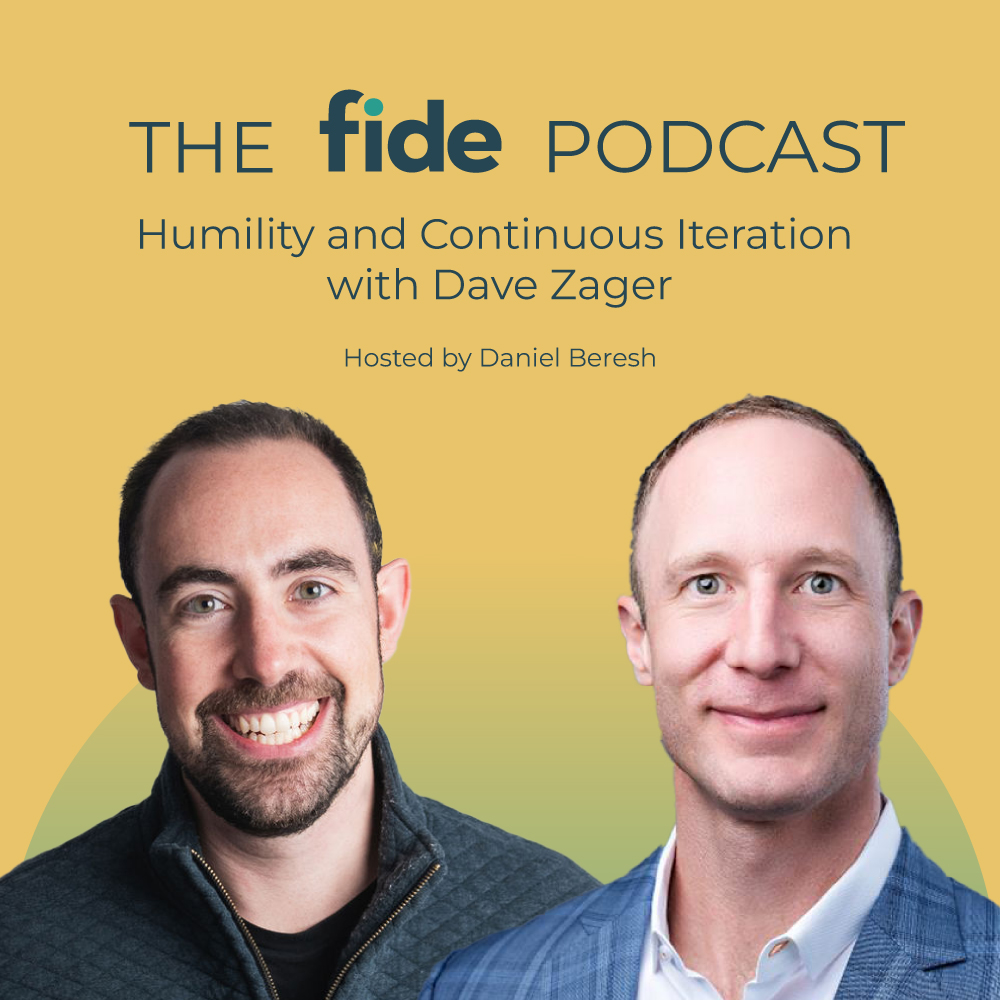
Dan sits down with Dave Zager, Deloitte’s Global Workday FSI leader, to talk about how he’s positioned his team as THE leader in the market.
Key takeaways:
🎯 Be relentlessly focussed on the market. Learn and relearn what the market needs. Don’t make assumptions.
👂 Marketing & Comms is a two-way street. Launching a piece of communications is only the beginning. Listen for feedback and iterate.
🏣 Create repeatable solutions based on your understanding of where company needs overlap.
⭐️ Create a north star to help you make decisions quickly. Stop waffling on low-impact choices.
Dan Beresh: [00:00:00] As a consultant, you work hard every day, but to grow your practice, this is no longer enough. You've got to figure out how to talk about what you do in clear, concise, and convincing ways. You have to position your team as experts in the market. And of course, this is really easy to talk about, but in reality, hard to do.
And that's where the Fide podcast comes in. We interview experts in the space who've been doing this successfully for a long time to give you that leg up. And we're all about actionable takeaways, which is why we start each episode with three pieces of solid advice from our interviewee, followed by a longer discussion.
I sat down with Dave Zager from Deloitte. We talked about the need to be humble, to keep that beginner's brain, even after you've been working in consulting for years, to understand the nuance of different companies, different industries, and ultimately to stay ahead of rapid change in the market. Let's dig in So Dave, it's really exciting to have you here on the Fide podcast.
I really appreciate it. And why don't we start with just a little bit of an introduction? Can you tell people [00:01:00] who you are, where you work, and what you do?
Dave Zager: Thanks, Dan. Thanks for having me today. So my name's Dave Zager. I'm a partner at Deloitte Consulting. Um, I've spent the better part of two decades here.
Um, and my main current role at Deloitte at this point is, um, I lead all of our global financial services offering for the Workday technology in terms of their financial products.
Dan Beresh: So for those people who are looking to do something similar in their own field, what are the top three things that you would recommend they do?
Dave Zager: I think the first would be, um, just to have a relentless focus on the market and what's happening in the market. And as you develop your hy- hypothesis of what that is, to make sure you're surrounding yourself with, um, with people that you trust that can, quite frankly, poke holes in your thinking. Um, a [00:02:00] lot of times, you know, when we have a hypothesis, we, we so wanna make it true, and especially if you're grounded in that day in, day out.
It's really important, um, if you believe in, uh, a solution or an approach or anything, to me, to, to have people around you, um, that have experience that you trust, to basically ask them, "Why won't this work?" Versus kind of hiding behind what you believe and, and pushing it. So I think once you, once you formulate that and you understand the market, then it's, um, then it's really, you know, getting your at bat, so to speak, and, and testing out what you believe, whatever your, your service or what you wanna provide as an impact to serve that market, that you're getting out to clients, prospects, peers, et cetera, and talking through, um, what your solution is or how you're thinking about it, [00:03:00] and really being relentless on the focus of how is this solution nuanced for each of the audiences that, um, I'm talking to.
Um, and the last thing, it's important to realize no matter how much experience you have, really to keep a beginner's mind. And what does that mean? Uh, what it means is if you've been serving a specific market, maybe for your whole career, um, and a specific technology in that market or, you know, a specific, uh, business area- That when you go from business to business, it's not good enough to say, "Oh, I've seen this, you know, a million times before.
I know what to do." Every business is nuanced, every client is nuanced, every industry, every market, and by the way, that's changing every day. For me, I always re-remind myself when I'm meeting someone new that [00:04:00] everything they're saying, uh, while it might sound super familiar, 'cause I've seen it time and time again, there are aspects to this business that are gonna be different than anything I've seen before, and it's really important to keep that beginner's mind, to, to actively listen and really tease out the real issue and/or, um, expectation that that client has.
Dan Beresh: Dave, that was a fantastic introduction. Thank you. So much to talk about there. I wanna underline a couple of points, and then let's, uh, kick it into a bit of a, a larger discussion. The first thing that I, I wanna say here, and I think it's so important, this is not just a step one, two, three process. This is a continuous process that needs to be revisited as much as is possible and iterated upon, right?
The market is changing faster than ever, and it's a matter of having that beginner's brain and saying, "Okay, yeah, this worked for me a few months ago. Let's revisit it. [00:05:00] Let's make sure that we are continuously talking to those folks in our network and really challenging the assumptions that we're making."
And I see this a lot in communications as well, where we'll write a narrative, we will create copy for a website, we will create a video, and we launch that project, and everyone pats themselves on the back and says, "Hey, job well done." Well, reality is, that to me should be the beginning of a two-way conversation, not the end.
It should be, "Okay, we launched this into market. Now, how is the market reacting? Let's show some of our trusted colleagues, some of our clients who we've worked with for years and say, 'Is this effective? Does this, does this communicate our message in a way that encapsulates the entire value that we provide?'"
And so really, to me, it's about not making assumptions about what other people are gonna understand, about continuously challenging the way in which we communicate about that, and making sure we're not using [00:06:00] jargon, and that we communicate ultimately in, in a way that's simple, easy to understand, and where people can say, "Yes, I get it.
This is, this is the value you provide." So I think just that, that constant iteration and that humility is such an important element of this to, to make sure that not only we get it right today, but that we're gonna get it right, you know, going forward into the future. So Dave, I'd love to back up a little bit now.
Let's talk a little bit about your Workday Financial Services offering. How have you positioned that as the leader?
Dave Zager: Yeah. So, you know, at Deloitte, we really pride ourselves on marrying the cross-section of industry and technology. So it's not good enough to just go to market with a specific technology without the industry expertise.
Um, what we found specifically in financial services over many years, um, is that it's, it's actually even more specific to the sectors within financial services. So as part of [00:07:00] financial services, that includes insurance, banking capital markets, investment management, and real estate. And all of those sub-sectors have a, um, a nuanced, um, approach in the marketplace, and we've taken a lot of time to focus on the changing market in each one of those sectors, um, how to apply the technology, and also staying current and relevant with leveraging new capabilities in technologies to serve those clients
Dan Beresh: Yeah, it's interesting you speak about that because so often I think we can think about a vertical, and especially when it comes to marketing and getting yourself out there, you think, "You know, we're gonna be in financial services, and we're gonna kind of paint that whole sector with a broad brush." And the reality is that every sector has sub, uh, you know, subgroups, sub-services that are offered, and each one of those has its own, its own [00:08:00] nuances that really need to be thought of as, as different, and treated differently, and, and, and, and spoken to differently, right?
Dave Zager: That's absolutely correct. So I- I'll use a, a good example here. Um, diving into financial services, you know, when we go into the market and talk to some of our investment managers, of which by the way, there are several sub-sectors there, right? You have PE firms, you have hedge firms, uh, et cetera, which operate vastly, you know, different, uh, differently in their, their business acumen and their approach to the market.
So taking a insurance lens or a general financial services lens when you're stepping into a private equity firm, you're, you're not comparing apples to apples, so to speak. So where, um, we've found a lot of success in this space is really having a relentless knowledge of the sector, really understanding what [00:09:00] trends are occurring in the sector, playing that out with our clients, and then, um, really priding ourselves on helping to stand side by side with those clients and align to what their issues are and creating impact with them to those issues.
So one of those areas we've done that recently, um, we just released, uh, a new asset from a Workday standpoint. Um, we're the only partner in the ecosystem that has this with Workday. It's called Invest Acceleration, and this focuses specifically on that sector of investment management with the technology.
It marries the two together, and it gives clients an appreciation, um, and allows them to touch and see what the future could look like, very specific to the business process that, that they run. Um, also a, a lot of the trends that are occurring in the marketplace, how that asset [00:10:00] marries to those trends
Dan Beresh: It seems to me like the, there's a, a bit of a sliding scale.
How deep do you go in a specific vertical, in specific areas within that vertical where you start to say, okay... 'Cause at some point, I mean, there is a s- you have to stop at some point, right? You have to say, "We're gonna make this asset for investment management." And you could have gone deeper and made three or four assets for different specific types of, uh, of investment management, right?
So how do you decide where to stop kinda distilling and say, "This is a group that I think we can serve as a whole"?
Dave Zager: So there are components, um, within finance that are pretty standard across not only these sectors, but also industries. As an example, um, accounts payable, you know, paying your liabilities off to, uh, to suppliers, generally speaking is going to be a, [00:11:00] um, straightforward process for most industries, and the nuances aren't, um, aren't as vast.
Versus, excuse me, how you're gonna allocate revenue, as I said before, how you're gonna allocate expenses, very different in an insurer versus a bank versus, you know, investment manager. So we like to call it, and it's kind of known in the industry as like, "What's the last mile of creativity?" So depending on the, the sector, a lot of this, um, capability, such as accounts payable, can be, uh, peanut butter spread a little bit across.
But where the, uh, the high impact areas exist for these clients, usually where they're feeling the most pain or they really see a market competitive advantage to take advantage of, those are the areas we're focused on to really double down on.
Dan Beresh: And, and s- it seems to me it's really whatever sector you're in, it's about [00:12:00] having that deep knowledge of your clients, not making assumptions about what you think they need based on the other experience you've got over here, but really asking the right questions and drilling down into, okay, this is, this is a sub-sector of clients that, you know, we can serve in a similar way.
Obviously, you're gonna serve every client in a unique way, and e- each client has unique needs, but, um, but, but, you know, at some level you have to, uh, you, you, you have to paint it with a bit of a brush and say, "All right, this is, this is kinda gonna be the group."
Dave Zager: Very true, yeah.
Dan Beresh: Dave, I'm, I'm curious then, when you think about, I mean, taking this asset for example, uh, you're, you're going to market with this asset.
You have, at this point, kind of an, it feels like an infinite number of ways you can talk about it, right? I mean, you could come on this podcast, you could write an article, you can make a video, uh, this, that, and the other thing. So where you... When you sit there and say, "All right, we've got this really exciting new product," what's the best way, in your view, [00:13:00] to get the word out?
Dave Zager: You know, I think first, LinkedIn's a pretty solid platform for disseminating, um, knowledge in this space, especially with quick, quick hits that can, you know, go across a broad market for someone that's, um, looking, um, in their industry, in a technology, things of that nature. So that, that's at a high level.
Um, I would also say, you know, a lot of the marketing that our, uh, our team at Deloitte- goes through in, in isolating demographics and figuring out where the best audience and, and the applicable medium for that, whether it's a, you know, a, a link to a webpage that has a video, whether it's setting up a call, et cetera.
Um, a lot of these things are really to get the word out and the knowledge. It's less about convincing a client they need to do [00:14:00] this. Um, however, where it really comes into play i- in the medium is finding, you know, and understanding a client that's, uh, that's experiencing either, um, a growth, um, event in their business where they're looking for a technology that can support that, looking for creative ways to potentially cut costs.
There's an impetus behind why they're looking at new technology in, in their, um, respective market. And when we meet with that client, and instead of just talking to them at a high level or pulling up PowerPoint slides, it's really around bringing, in this case, the asset to that conversation and going through it, not in a scripted way, but in a way that will help them envision what the future [00:15:00] looks like.
To me, that's the biggest compelling offer to a lot of what's in the market today. It's really clients that wanna see, touch, and feel something very easily without necessarily committing to a whole, you know, multiple workshops or a cost. It's, it's almost like within an hour, I wanna paint this picture of what my future could look like.
And if interested after that, then going down the path of double, double-clicking into those areas.
Dan Beresh: I think that's such an interesting thing you bring up because we talk about this so much in the work we do. It's about figuring out that aspiration, right, that your client has, that dream state that, that you're gonna take them to.
And whatever position you are in, you know, the marketing funnel or what- whatever you wanna call it in terms of that sales journey, I, I think it's about figuring out, okay, you know what? We can, we can take you to this place where [00:16:00] you are no longer bogged down with these processes, where you're no longer having to do this, that, and the other thing.
It's all handled, taken care of, right? And, um, and so it, it strikes me that, you know, if you're, you know, if you're posting on LinkedIn like you mentioned, or if you're in the room with a client, regardless of where you are in the journey, it should be based in this concept that you are selling them the, the dream, the, the benefits, the outcome, and, and the potentially better life they're, they're gonna live.
Dave Zager: Yeah, I think there are two things there.
One, um, when the explanation of what is trying to get achieved comes out, before just taking that as given, it's really important to drill into that to make sure that if you could fast-forward at the end of a potential engagement project transformation [00:17:00] and say, "If we did everything that was called out in the beginning, is this really successful?"
Because sometimes we find that the pain that a certain client is going through will be resolved by the, the transformation, but that's not actually gonna get them all the value that they could potentially get. So I think it's really teasing out the business case, teasing out what they're trying to achieve, and make sure that you're all on the starting line together saying, "In the end, this is what it's gonna look like."
Then from there, once you're grounded in the vision and, and how it's going to get achieved, then it's a relentless focus, not just on what we set out on this project or program. Did we get it done? Was it done on time? Was it done under budget? Of course, all of those things are extremely important, but we look at those as table stakes.
It's [00:18:00] more along the lines of did we achieve what we set out in the business case? Long after the transformation is complete, did we achieve the market growth we were looking for? Did we achieve, you know, the, the initiatives and the top five reasons, you know, we went about doing this? Because a lot of times you lose sight of that when you're going under, um, a great deal of transformation, and it's important to, uh, to keep that baseline as to why, why you embarked on doing this in the first place in mind.
Dan Beresh: You know, this happens, I think, in a lot of businesses. It happens with us all the time. We set out to help our clients achieve their goals, get their, their message out, uh, get their marketing out there, and we get caught up in the tactics, and we get caught up in the little minutia and the details. And I imagine on these projects you're doing, I mean, these are huge transformations, right?
There's a million details to get caught up in, and it's a great reminder to [00:19:00] really make sure you have that kinda North Star vision and, and that you continue to come back to it. And something that ha- happens in our projects sometimes is we, you know, we'll align on that vision, but we get caught up, our client team gets caught up, and suddenly we're talking about these, these decisions.
And if you just look back at that North Star that you identified, it's actually really easy to be able to make that decision and say, "Hey, everyone, you know what? Remember, this is, this was the ultimate goal that we set out on, uh, you know, to do." Um, and, and, and that, you know, bringing us back to that, that, um, that initial kind of way of doing it is...
Or excuse me, back to that North Star is, uh, I, I find something that's really, really, really helpful for us and, and actually helps us to move faster in some cases.
Dave Zager: Yeah. You know, at times we'll, we'll actually print out what that North Star is and put it on every wall in every room to re-remind us, you know, and, and the client at meetings as to what that truly is.
Now we're in a remote world now, so you can [00:20:00] print that at home. But, um, it's easy. I mean, we're, we're human beings, right? So anything that's gonna last more than two to three weeks, we'll, we'll kinda focus on what we're in and the immediate needs a lot of the times and forget that, you know, a nuanced decision here or there isn't going to really change that overall vision, although it's extremely important for the day-to-day, you know, project management of, of what you're trying to execute.
Dan Beresh: Yeah, and I think we often get bogged down in decision-making in general in business. And, you know, Amazon loves to say, a lot of decisions that are made are reversible. And yes, they impact timelines, and yes, you know, you do wanna make the decision, the right decision every time. But sometimes taking a week or, or how many ever days to, to make that decision that's actually not that high-value a decision, you might as well just, just choose something and just move forward and, and keep that North Star in mind.
And, and hopefully that allows you to kinda move in a way that's, that's a little bit faster. [00:21:00]
Dave Zager: Yeah, what I've actually found, and it- it's easier said than done, I've been doing this over 20 years, so you just see time and time again different projects, different technologies, different industries. Um, but, but something that holds true regardless of all of that is you're really better off making a decision, even to find out it was the wrong decision months later, than iterating for weeks and months at a time and stalling, especially in the, the market we operate in today that is so fast-moving.
Um, and the reason I say that, um, at least in what we do around technology, um, solutions in an industry, is that within technology you can change it. You know, even a decision you make today which turns out to be the right decision today, five years from now when you transform your business, it's not gonna be the right decision anymore, and that's [00:22:00] okay.
Um, building something that's not set in concrete for the foreseeable future, but something that's agile enough to, to move with your business vision but also support the day-to-day is critical. And to be honest, it's hard to talk about that in words. Clients wanna understand the how. How, how is that even possible?
Um, and some of that comes out in, in, in showing clients and, and making them, you know, touch it and feel it, as I said earlier. But that's just the business world we operate in today. Very different than, you know, two decades ago.
Dan Beresh: Absolutely. I, I wanna bring us back to something you talked about just briefly, which is LinkedIn.
Because when you go to put your product out there, when you go to put yourself out there, and y- I've seen you on LinkedIn, you're amazing, right? You've really got it, you really got it down. There's, but there's so much garbage, and with the age of AI, we are gonna see more and more things [00:23:00] that are not written by humans that are just fluff.
And I think we're so used to scroll, scroll, scroll, scroll 10 posts and you're thinking, "Oh my God, have I gotten anything out of this? Like, what am I doing here?" Um, how do you create content on LinkedIn that people are actually gonna wanna click on?
Dave Zager: It's a great question. And to be fair, I might not be the best person to answer this, given that my only social media, both, uh, professionally and personally, is LinkedIn.
I'm, I'm not on anything else. Um, but I would say as someone that, um, looks at LinkedIn, you know, every day for a couple minutes, I think a lot of it is based on the algorithm of what LinkedIn is showing me. And when I read something, all the time, I mean, it's really who's putting it out. Um, I'm looking at the, you know, is this a friend?
Um, is this someone that it's a second connection, I don't know who they are? I think a lot of it [00:24:00] comes down to your trust in, in that person or potentially that company, that brand, et cetera. But you're right. I mean, in the age of AI, and it's amazing we got 20 minutes into this podcast without using the words AI until now.
But, uh- ... you know, it's, it's quite interesting. Things, things are changing as we speak, and they'll be different a week from now and a month from now. So, um, we- we'll see the impact of that, but it'll, um, it'll be quite interesting how those platforms evolve to ensure, um, that the content that's getting pushed out i- is trusted.
It, it's an issue today, no doubt about it.
Dan Beresh: Yeah, and I think there are some new algorithm changes on LinkedIn as well, and what I've seen, what I've read is that it's all about trying to get down to trusted thought leadership that is genuinely found useful. And I mean, you gotta feel for the [00:25:00] people who are building this algorithm at LinkedIn because that is getting harder and harder to figure out what it is.
Um, you know, I'm sure there, there are millions of bots out there, and then with the advent of people writing things on AI, uh, it's just gonna get harder and harder, and I think we're gonna have more and more noise, and it's just, it's gonna be, um... It's gonna be an interesting world seeing what, what LinkedIn looks like and if they are able to keep up with that and able to, to, to feed us, to, to serve us things that, um, we genuinely found useful.
Dave Zager: Yeah, I agree. I mean, in, um, listen, in my personal life and in my professional life, the, the word trust has always come to mind. Um, you know, when, when clients are embarking on big, heavy, transformative, um, opportunities that quite frankly their, their job's on the line to deliver, you wanna go to someone you're gonna trust.
Same thing with, you know, personal friendships. People, if they trust you, um, and trust you to tell them the real answer and not what they wanna hear, that's really what [00:26:00] it comes down to. It's, it's how much do you trust somebody? So I don't think that will change, um, in the future. I just think how, um, the market will adapt to, um, a lot of noise and how to sift through what's trustworthy will change drastically.
Dan Beresh: Yeah. Yeah, I think that's right. And we're still gonna be humans at the end of the day, and we still, to your point, we still wanna trust one another. We wanna have our, our tribe of people who, you know, are in our in-group and who we know we can rely on. And, um, it doesn't matter how much AI or how much content is out there.
I mean, yes, it's gonna require more filtering, but it kinda comes down to that at the end of the day. Well, Dave, looks like we're almost out of time for today. I wanna thank you so much for coming on the Fide Podcast. Means so much to us. It's amazing to get your insights here. This has been amazing.
Dave Zager: If you're interested in anything that we've talked about at a high level, feel free to, to connect with me on LinkedIn.
Um, you know, direct message me. [00:27:00] Happy to, to connect. But thank you for, uh, for the time today. Thank you for taking time out of your, uh, your busy calendar as well and having me. I really appreciate it.
Dan Beresh: Dave, thanks so much. For those listening, my name is Daniel Beresh, and I am the founder of Fide Creative.
We're a company that helps consultancies to go to market, clarify their messaging, and make creative assets that ultimately fill up your sales pipeline. If you want more information, we've got thought leadership on our website. That's fidecreative.com, or feel free to connect with me on LinkedIn.
I'm Daniel Beresh. Until next time, thanks for listening.
