
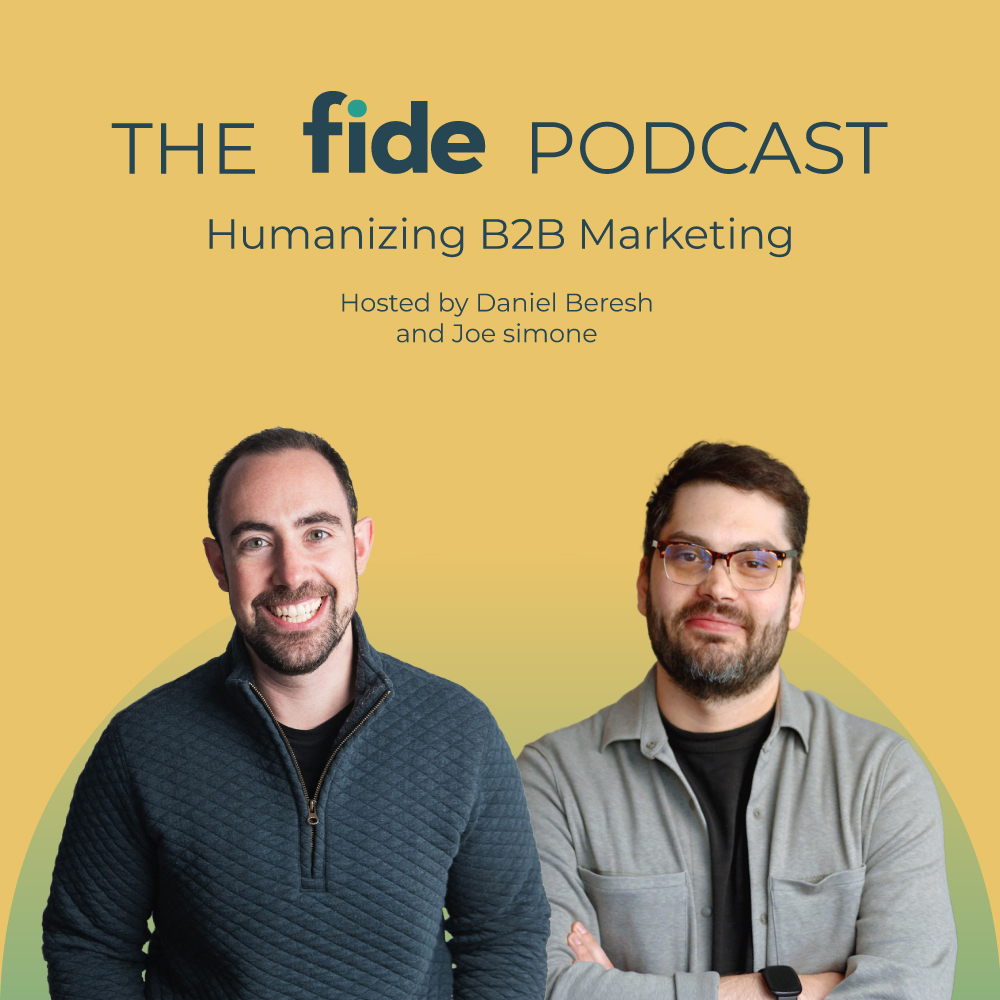
When every firm promises "transformational value," how do you make your message stand out? In this episode, Dan and Joe talk about the real work of humanizing B2B marketing. They explore why specificity matters, how to craft messages that reflect your audience’s real problems, and what to do when internal politics force subpar spokespeople into your content.
The episode also digs into smart use of AI: how to train a GPT on your brand’s voice, filter content through your ICP, and why out-of-the-box AI is a trap.
Whether you're struggling to get buy-in or just want your content to feel less like it came from a bot, let's talk on how we market like humans again.
Dan Beresh: [00:00:00] I founded Fide because I felt like I... You, you know, there was this moment I was standing in the train station in downtown Toronto, and I saw all these ads for a professional services firm that will go unnamed, and I just thought, "Can we not elevate this a little bit more?" It's polished, it's very professional, but I could swap any of the other big four brands out and it would be exactly the same.
It has no voice. Mm-hmm. It has no soul.
Joe Simone: Yeah.
Dan Beresh: I just don't... I don't know, Joe, I just don't think that you can speak like that if you wanna stand out, and the competition is getting fiercer, and I think the market's demanding more of professional services firms.
Joe Simone: Yeah. I, I, I have a similar experience. You know, whenever you scroll LinkedIn, I, I will say it's getting better, but for a very, very long time, when you see posts from these brands, they just lack any kind of soul or human element.
It just all feels so vague and nebulous, and you're just left trying [00:01:00] to figure out what it is exactly we're saying. They're saying everything and nothing at once, you know what I mean?
Dan Beresh: Yeah, yeah, yeah. We're, we're gonna provide transformational value.
Joe Simone: Yeah. What
Dan Beresh: is that? It's like someone in a dark basement wrote it, someone who hasn't, like, stepped outside in a while, you know?
And you kinda, you kinda feel bad. You're like, "Can you, can you just take a look around at the, at the market and, um-"
Joe Simone: Yeah, we've talked about that word before, value.
Dan Beresh: Yeah. I love it, you hate it. And this is kind of interesting, right? 'Cause I'm a, now I'm a business owner. I'm, like, a creative turned business, so I feel like I kinda have...
And maybe I said this to- yesterday to you, right, is like, "Maybe I'm just becoming a business bro."
Joe Simone: No, I don't think it's that. Like, it does... The word value has value in certain circumstances, but it is very much this kind of catch-all word that, you know, I, I love specificity and I love just getting straight to the point.
We deliver value. W- what does that mean? You make things better. Still, what does that mean? Like, it's just, it's, it's too [00:02:00] vague for my taste.
Dan Beresh: You have this interesting pull between the need to be specific because you're selling specific services, but also, oh, I'm in a marketing role and I'm marketing all of these services across a huge organization.
How do I be specific without alienating certain groups? And I mean, certainly we talked about that in our last podcast. I think we created some, some good ideas as, as to how you can avoid that kind of genericization, um, that comes around as a result of, uh, you know, sometimes just asks coming in randomly.
And, and, and the idea that we presented last time around that sub-identity that we've done for a few clients, I think is a good one. But let's talk about, uh, our, our subject today, which is really about just humanizing, uh, B2B and professional services marketing. I just don't think you need to be so polished and so formal all the time, and I think we're seeing a move toward a much more human, what I've called, what I've seen is [00:03:00] called c- the consumerization.
Joe Simone: You're... I think you're seeing it more, and I, in my experience, leaders in particular have been hesitant to do it. But I think you should be putting your people front and center rather than just your messaging. People trust people, not just blank statements or facts. So the more we can inject actual people from the company rather than this voice of God brand voice, I think it's a little bit easier to trust.
Dan Beresh: Well, it certainly is. And just look at LinkedIn. They have continually downgraded the reach of company pages.
Joe Simone: Mm.
Dan Beresh: Because I just don't think people wanna see content from a faceless organization- Yeah ... that says, you know, transformative value. They wanna see that partner, that leader who is a thought leader in the space, who knows a lot.
And let's be honest, that's why you're hiring a consultant in the first place, is to get that specific expertise. We did a project in the fall where it was a, a contact center [00:04:00] transformation, um, and we were talking about the, the outcomes, and they said, "Look, we were so confident about the fact that we could do this that we were, you know, complete contingent fee delivery."
That's, that's confidence, and that's the kind of thing I think you wanna buy.
Joe Simone: Mm-hmm.
Dan Beresh: So Joe, if we wanna humanize B2B marketing, if we wanna make it more interesting, more relatable, more relevant, what do you think? What do we do?
Joe Simone: Uh, I think you have to take a stance that might alienate a little bit. You have to have an opinion, and it's not just being, you know, controversial for, for the sake of it.
It's, you know, seeing what's worked for you and sticking by that with conviction.
Dan Beresh: But, I mean, you're alienating folks. Like, don't you, especially in a big four, you kinda wanna cast the net wide, don't you? Like, I mean, I can imagine [00:05:00] someone saying, uh, especially as a marketer, like, "I don't wanna get fired, you know?
I, I gotta, I gotta keep the party line going." And also, to what extent is this my voice? To what extent is it the company's voice?
Joe Simone: I mean, it's a line you, you, you kinda have to tow, but I'm personally about injecting personality into those messages and taking a stance. And if you alienate people, then you alienate people.
You're not, you're not gonna catch everybody. People are still gonna swim through your wide net that you cast. So tr- you know, maybe if you narrow your focus a little bit, you get more of those folks agreeing with you.
Dan Beresh: Yeah, and I think something that you can do as well is put those market-facing people in positions where they are your front and center.
Those are the people whose voice it is, right? So just 'cause you're a marketer doesn't mean if you have an opinion about something, doesn't mean you need to, you know, share that on the, on the page. I'm not the
Joe Simone: voice of the brand.
Dan Beresh: Yeah, exactly.
Joe Simone: This is just, I work for the brand, but this is my opinion.
Dan Beresh: In, [00:06:00] in creative, we like to say, "Write what you know," and so I think in a marketing, in especially in a big marketing sense, it's like find someone who does know and then tell that story or have them tell the story, and that's gonna be more captivating than just putting out, you know, this, this kind of, the stuff we see on LinkedIn every single day, which is, "We're hosting a webinar about this topic at this time."
Done.
Joe Simone: What, what would be a better title for that webinar?
Dan Beresh: I, one of the things that I love is this idea of creating this knowledge gap. So you start off with something that doesn't tell everyone 100% of, you know, what you wanna tell them- Mm-hmm ... and immediately it gives them that reaction. I think you have to play to people's, um, you know, emotions and, and, and needs to know or desires to know.
So, like, a better title than we're talking, you know, electrification, like fleet electrification webinar on Tuesday.
Joe Simone: Mm-hmm.
Dan Beresh: [00:07:00] It's, it could be as simple as 10 problems with fleet electrification- You know, webinar- webinars on Tuesday and, and your plan is to go over that, or where we've seen fleet electrification hit road bumps or even fail and, and how people would do that.
Yeah, you
Joe Simone: need some kind of hook to get people's interest. Hooks, we've- we were taught them in grade school when we were writing our first essay. Dude, you need to convince somebody to give you their time.
Dan Beresh: And I think in this context, it's about opening up the right knowledge gap and having the right hook that for that specific audience you know is gonna be effective, and I think that's where the secret sauce comes in.
Any thoughts, any recommendations as to... It's easy for us to say, "Hey, open the knowledge gap." You know, ask the question. How do you, how do you do that correctly so that you know you're gonna be effective with that on- with an audience?
Joe Simone: I think you have to know your audience, and if [00:08:00] you don't know your audience, you're doing yourself a disservice.
I- if you know what your audience cares about or you know what they're up against or you know what keeps them up at night, those burning questions, lead with that. L- and, you know, hint that you have the answer. If you, if you told me you had the answer to something that keeps me up at night, I, I'd pay you money to give it to me.
Dan Beresh: That's something that I bring up frequently with our clients, is our clients are up at night, right? When it comes to the C-suite of big organizations, especially in a time right now, there's so much volatility, there's so much uncertainty.
Joe Simone: Mm-hmm.
Dan Beresh: And you see the BlackBerrys of the world that didn't make the right decision.
No one wants to be in that position, and the fear of becoming that company is very stressful. So playing off of that as much as you, you know, can or feels reasonable is good. But actually, we had a- another good discussion about this, Joe, where, uh, [00:09:00] you raised a great point, I think, which was around not playing too much to the negative, right?
Because I'm a- I, I would play to the negative a little more than, than you would.
Joe Simone: It's about... It- I don't think it's about the negative and creating a sense of fear. It's kind of two sides of the same coin. It's creating a sense of urgency and the cost of inaction. I wouldn't say it's you need to inject fear into it.
Let them do that themselves. But if, if you're able to create, if you're able to say what might happen if you don't act now. AI, for example. If you're not on the train, the correct train Who knows what's gonna happen to your business in the next year or two?
Dan Beresh: Yeah, and I think there's two sides to this, right?
The fear and the negative angle typically speaks to inaction doing anything. If you are pitching yourself as that [00:10:00] SAP implementation partner- Mm-hmm ... well, inaction is implementing SAP, not necessarily hiring Accenture, Ca- you know, whomever you are. Yeah. So then you gotta take it a step further, and I think that's where a positive can come in as well, and where it's important not just to say, "Hey, don't, you know, don't not be on the train," or, "Don't be on the wrong train."
I think what we're seeing a lot of people say, which is very smart, obviously, is, "We know what train is the right train."
Joe Simone: Well, you have to, you have to have that confidence. Yeah. You have to take that stance, like we talked about.
Dan Beresh: Yeah. But I don't think you can take the stance as a generic company that just broadly messages about everything and, and here's the value.
I think it has to come from a subject matter expert who actually says, "I know how to get you on the right train." 'Cause the clients are smart. Mm-hmm. Clients in this industry are, are extremely intelligent people who I think can read a, a marketing message in an instant and immediately have an opinion about it and say, "Yeah, maybe," or, "Absolutely not."
Joe Simone: What happens if that subject matter expert [00:11:00] though, you know, sure we c- we can ask them to write a post or we can write a post for them or we can put them on camera. What if it's just not- maybe the best voice or most concise voice. Maybe I answered my own question and, and that's write it for them. But how, how do you solve for that?
How do you make sure that the subject matter expert you're using is the right voice to use?
Dan Beresh: I'm so passionate about not filming anybody or not putting anyone- ... kind of, you know, as the subject matter expert. I mean, I think it depends on your medium, right? Mm-hmm. You can help someone to write a great article even if they have no presence, but I think that getting that person on a video could be a big mistake.
We do casting. Like w- in a, in a corporate documentary, we will reject people from our videos. Thank you so much, you know, we appreciate your interest in the video, and, and we don't [00:12:00] take, uh, role into account. Sometimes these people are partners, and it's hard to say no to a partner.
Joe Simone: Yeah.
Dan Beresh: But-
Joe Simone: W- we had a big lead that we had to pretty much cut out of an entire video.
Yeah. W- we managed to, to squeak them in, but for the most part they were not in that video just due to poor delivery.
Dan Beresh: Yeah, I mean, I... So on one hand it's, we cast and we do upfront interviews and we say, "And w- is this person gonna be interesting?" 'Cause especially when you're talking about an external audience-
Joe Simone: Mm-hmm
Dan Beresh: nobody cares about the product you're selling and nobody cares about your company hierarchy. No. People care about their own problem and can you solve it? And you need to put the person on camera who is going to be the most passionate about the delivery and actually convince somebody. But I mean, it, it's so easy to say, we're gonna try to make everyone happy- Yeah
and, you know, we've gotta play politics and things like that. This is a really challenging thing, I think especially for internal teams.
Joe Simone: Huge for internal teams. One o- that was my problem every time was-
Dan Beresh: Mine too ...
Joe Simone: you were forced to put this leader on camera [00:13:00] for visibility and, you know, they are not camera trained, and you can, you can spend as much time as, as you want with them.
By the way, you maybe get an hour with them trying to train them up to how to deliver properly and engaging, and- Most of the time it just doesn't hit the mark, uh, but you're forced to use them. You don't really have that leverage to say, "This is not going to serve us well. We're gonna put out a subpar video, and it's going to hinder rather than help."
Dan Beresh: I actually think this is where we as an external agency can and do take the fall. It is gonna get you a better result, and, uh, you know, when I was at Deloitte as well, it's, it's like I wanna preserve my career at the firm, so I'm not gonna say no to this really powerful partner. But the result is that you end up with marketing that fades into the noise, and that's just exactly the same as everyone else is putting out, and I just don't, I don't think you can do that.
So that's actually, that's a great way to use external agencies, and if you know you're gonna keep using the agency and you like them and you like the work they're [00:14:00] delivering, then, uh, you know, t- to have, to blame them and to have some partner say, "Well, that, that silly agency, you know, didn't put me in the video," and grumble, grumble, grumble, and then that goes away in a month or two, and- Yeah
you all forget about it and you move on. And-
Joe Simone: Exactly ...
Dan Beresh: that's how you actually, you're, you're effective. Yeah, we've talked a little bit about spotlighting people- Mm-hmm ... and I think that's, that's a big theme that I'm, I'm, I'm ha- hammering home today, is I think we have to stop this whole, you know, corporate tone of voice perspective that's, you know, this is gonna be our, our brand voice.
There's gonna be a moment where you have that out of home ad, you have that social campaign that, you know, it has to have- It doesn't go
Joe Simone: away.
Dan Beresh: Yeah, exactly. But I think the more you can infuse real people and realness, and I think this is ... We're gonna see more of this. AI is already taking over everybody's LinkedIn feed.
Ugh. It's taking over marketing. We're being asked, you know, how can you create AI-based [00:15:00] videos? And it's not that there isn't a place for that, but you have to build trust, and AI is, is kind of the opposite of that. And in a world where everyone is creating things with a prompt
Joe Simone: Here's my problem, and I, I, you know, I think we have a solve for it, and we'll get to that.
But my problem is when I see these, my LinkedIn feed, and it's, uh, the formatting has just the stink of AI. You see the emoji bullets. You see, I know this is a point of contention for you, the em dashes, like-
Dan Beresh: I love an em dash. But
Joe Simone: I've- Well, that-
Dan Beresh: I'm upset 'cause I've been using them for years, and not with AI.
And now, now I can't use my, my sweet, sweet em dashes.
Joe Simone: I think you're the only person who knows how to actually use them. But-
Dan Beresh: Shift, Command, dash. Okay, everyone listening.
Joe Simone: There it is. But, you know, uh, people are just taking their... I think they're writing in ChatGPT with their personality, but what's getting [00:16:00] spit out is just ChatGPT.
And like I said before, you can just, y- you immediately see it, and they're not doing the due diligence of going back in and injecting themselves back in it. I, I, I think it's a fantastic tool to start. It gives you your baseline, and then I need to go back in and inject myself back in there because it pretty much erases me from what it outputs.
That is, if you're just using the standard GPT.
Dan Beresh: Yeah, we, we've had a lot of success, haven't we, actually training custom GPTs- Yeah ... um, you know, using our, our brand voice. And what's interesting, we were... Y- you know, when we look at using this GPT, yes, it kind of writes things in our brand voice, and it helps us to be succinct and all of those kinds of things.
But I think the bigger value that it's actually giving us is we put our ICP in there, and we talk about who we serve as a company, and then we have it filter, is this relevant to our ICP, or is this just some kind of internal [00:17:00] stuff? The internal speak is one of the biggest problems I think big companies have because it's so easy when you're surrounded by people who are all within your same firm to start speaking a certain language and feeling like certain things are valuable, and you are so far separated from actually what your customer cares about.
So getting that, that, training that GP- And by the way, I don't think it, it, this means to spending days and days training. And I actually think we saw this with Zapier, um, even a little bit less than a year ago. You go on LinkedIn, at least mine, everyone's, "Oh, I automated this. I did this. I did all this stuff."
Sounds great, but I've automated almost nothing in our company because I think it's a shiny object. We have some systems and processes where APIs talk together, sure. But I think you need value out of these systems immediately. And so I would say train your GPT for an hour.
Joe Simone: Yeah.
Dan Beresh: And then stop and then say, "Is this worth it?
Is this working? Or do I need to try something else?"
Joe Simone: So how did you train our, our, [00:18:00] our Fide GPT?
Dan Beresh: I guess I'm lucky, right? 'Cause I've been writing a newsletter for a long time. Mm-hmm. So that newsletter, I've intentionally written it in a succinct way. I know what our ICP wants, and I've been writing about that.
So I took our newsletter, I just made it into plain text files, I uploaded it into our, you know, paid ChatGPT- Mm-hmm ... and that has given us a sense of, of voice and also kind of what's, what kind of topics we've done. Yeah. I actually take these podcasts, I take the transcripts, and I also upload them in there.
And then I also instruct the GPT to, um, to take some, uh, some perspective on, you know, is this gonna be interesting to a professional service enterprise tech marketer? And, and the other thing I've done is I used deep research to feed into that as well. So I'm, I'm going out, I'm doing deep research about our ICP And not to get too technical, I'm, I'm using a large reasoning model, more like an o3 or an o3 pro, uh, and, and that's feeding into [00:19:00] my large language model, like a 4o, that is the, that is the, the writer for us.
Joe Simone: Yeah. I use the 4o all the time for our copy and stuff like that, and it's, it's just incredible how easy it is to stay consistent in our brand voice while also being able to inject a little bit of myself in there.
Dan Beresh: How much of yourself do you need to add?
Joe Simone: It depends what I'm writing for. There is a balance.
You don't want everything to... Like, if, if it's copy for the website, sure, it can, it can be, it can be entirely the brand voice. But if it's something I might wanna post or if it's some copy we're writing for a client, I do want to inject myself in there a little bit just to make it a little bit... Not that it's not human because it's a lot of your writing, it's just it's not me.
So it's more so making it a balance of the two.
Dan Beresh: Yeah,
Joe Simone: exactly. I don't, I don't necessarily [00:20:00] have, like, a percentage for you. There's just a gut feeling, I guess, like, this is good enough.
Dan Beresh: But what's really cool about the, um, the use of that AI tool even out of the box before you've rewritten, we started running that AI tool through checkers.
Yeah. And we have been able to train it to the point where it is undetectable as AI. So coming back to your point about the AI and the kinda drivel and all that stuff, I think we wanna stay away from what I would call out of the box LLM- Yeah,
Joe Simone: yeah ...
Dan Beresh: writing.
Joe Simone: Exactly. We're not saying don't use it. We're saying use it efficiently.
Dan Beresh: Yeah.
Joe Simone: Start with, with the baseline and then really inject yourself or the voice that needs to be injected in there so that it does sound human and not so, so flat and generic.
Dan Beresh: AI is the tool. AI is the lever. Use AI. Train AI. Enjoy it. Enjoy the productivity benefit that it brings you. But, but do not make the mistake of the snake [00:21:00] oil salesman on LinkedIn who is saying that marketing is over and everything's gonna be completely generated by AI in the future.
Yeah. Because if it is, then everyone raises the bar of marketing at the exact same time, and we are in a competitive environment where winning is about standing out and being better than anyone else. And if everyone is on the same AI tools, it- the AI tool is not what's gonna get you there in terms of winning in the market.
It really comes down to taking that stand, having that opinion, and I mean, that's, that's what we help our clients to do. We, we help them to communicate in a way that feels different, but that at the same time isn't a massive, massive risk, that isn't breaking the rules. It's, it's how do we be effective with the words we're using?
Joe Simone: Yeah. And injecting that humanness and personality to [00:22:00] stand out from the sea of the same.
Dan Beresh: I always say the market won't wait, and neither should you. And I would encourage you, if you're listening to this podcast, to really think about implementing this as, as soon as you can. How can you take little steps, iterative steps, to get humans into your marketing more, to put people, uh, at front and center, and, and to, to have that opinion and to, to speak in a way that, that feels like it's, it goes above and beyond that, that kind of generic speak?
And if that's something that you're struggling with, you need help with, uh, it's certainly something that we can help you with at Fide. So, thanks very much for listening to this podcast. I appreciate it deeply, and, uh, we'll see you next time
