
How do you come up with creative ideas?
How do you create a script that people will remember?
How do you create visuals that stick in your prospect's minds?
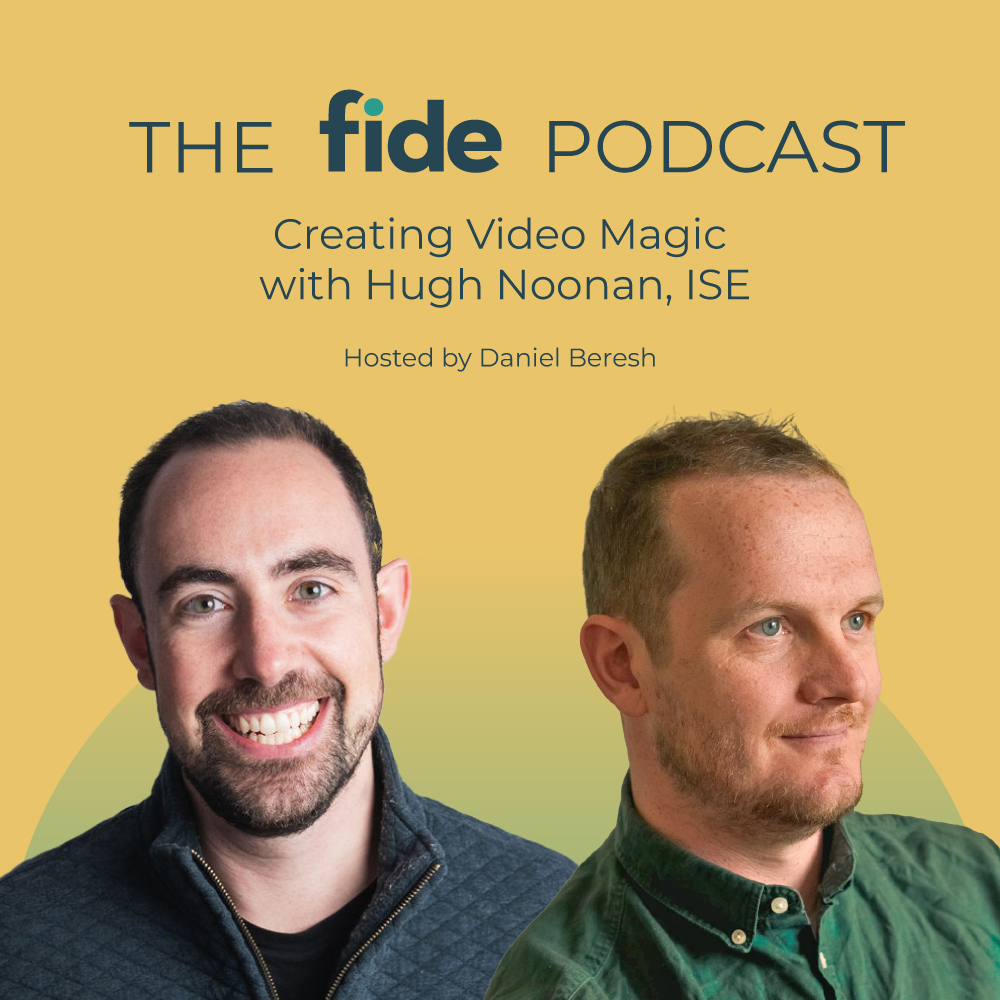
In this episode Dan Beresh chats with one of Fide's top video editors, Hugh Noonan, about how Hugh takes nebulous consulting concepts and transforms them into marketing material that moves the needle.
Dan Beresh: [00:00:00] Welcome to the Fide Podcast, everybody. I am so excited to have Hugh Noonan here. He's one of our best editors, and, uh, he is just such a talent, and I think what we're gonna get into today is, like, how do you go from really script to screen? We give Hugh these scripts that are very business-y, very nebulous.
We basically tell you, Hugh, to turn an intangible into a tangible, and you make magic happen.
Hugh Noonan: Oh, Jesus, Dan, that's a hell of an intro. Um, yeah, thank you very much. Glad to be here. I guess that's the skill that I bring. I'm such a daydreamer that I try to do that all the time, bring the intangible to the tangible.
Dan Beresh: Let's get into that. Let's talk about it, 'cause I wanna- I want people to hear your creative process. I want people to hear what you do to take that, that, that script and make it into visuals. And you know, one of the things that I've seen lately, I think, is, uh, a lot of people think, "Oh, we've got the script.
Great. Now the video is easy." I actually think that the script is the easy part, because when it comes to making it [00:01:00] visual, that is a, a huge challenge.
Hugh Noonan: Well, uh, you ask what the process is, and it's a challenge all the time. But I think what's so nice about working with Fide, it's, it's every level. Do you know what I mean?
You're getting in at the story level. You're getting into visuals. You're getting into sound and music, and overall, it's all driving what's our story. You know, it's all in service of that. My job is to pull together your vision plus my ideas, putting visuals I can pull together as quickly as I can to realize that story, do it as cinematically as we can, and hopefully, like, bring a new perspective that wasn't initially thought of before, but try and experiment quickly with ideas to realize the best, the best possible idea, the best possible story.
Dan Beresh: And I think, you know, we have a, a large roster of editors, but it's you, uh, I think more than anyone, I would say, that we wanna go to with these... I, I wanna even say difficult stories, like metaphor- Oh, yeah ... led stories that- Are they, are
Hugh Noonan: they re- Are you giving me all the challenging ones, yeah?
Dan Beresh: Well, because you [00:02:00] bring this incredible creative angle.
And I'm not just blowing smoke here. I, I, I
Hugh Noonan: hon- You blow a lot of smoke. You know, I'm Irish. We don't s- we don't take compliments well, so this is, like, really hard for me to hear. But I'll take you at your word. Go on.
Dan Beresh: The, the thing that I think you do is you, you do the metaphor correctly, and I think that's really tough to do.
Like, we're selling a variety of, of kind of intangible services, right? Like, you know, what have we, what have we talked about before? We had that one video, um, where the client will remain unnamed, but we're talking about selling used cars. Yeah, man. That was, that was, that was tough Because it's not, it's not actually selling the used car.
It was, like, creating a worldwide marketplace for dealers to actually, you know, interchange the used cars between them.
Hugh Noonan: Yeah.
Dan Beresh: Um, it's everything from that, and that, maybe that's a little bit more visual. I don't know. G- versus something where th- you know, we're, we're making a video that advertises, like, a report that's coming out about the future of work, and the last thing you wanna [00:03:00] see, in my opinion, is, like, a bunch of people sitting at a desk.
Hugh Noonan: Yeah, true. I mean, the, the car selling one, that was tough And as a process, I mean, I go into this really not knowing anything. I'm not the- I think there's an advantage to that though, isn't there?
Dan Beresh: Yeah. That
Hugh Noonan: we kind
Dan Beresh: of have that, and you bring this almost external, like-
Hugh Noonan: Labrador perspective. Yeah. I- well, I mean, that's the, that's the phrase that I take when I'm interviewing anyone, and these, these subject matter experts.
You know, ultimately they're giving me so many branded materials, there's a big brief, and half of it for me is, you know, simplifying it, distilling it down to, like, some of the most core aspects of what, how this is gonna benefit the end user, the end client, the service, and I really, really have to read and distill.
So I say to people, "If you can explain it to a Labrador, explain it to me," and I'll nod, and once I get it, then it clicks.
Dan Beresh: You know, I think what's a great relationship for a studio or an agency to have with an editor like you is we provide the brief, we provide the context, we tell you what you need to know, and yet you [00:04:00] come into it totally blank page.
And so you're not thinking, "I'm gonna replicate that video I made, you know, last week," or, "I'm going to just rip off this other thing." It, it's new every time, and, and then, then it's our job, I think, to push you at every stage to say, "I like this, but how can we make it just a little bit better?"
Hugh Noonan: I know. I know.
I love it, and I hate it. I'm saying that, I'm saying it a lot. It's like when I'm really bleary tired, do I really wanna hear more? But no, I think each time, as a process, I think we have a really, really good creative process for creating magic because it's, it's always what could we, could we do, fresh, uh, perspective, make it unique, make it different from everything else, like you say, but still, but still hit the same goals of really connecting with the end user, telling something human that really has impact and resonates.
It's not just what this piece of software does like you're reading an ingredient list. It's saying, "Here's something that can really connect with what you're dealing with," okay? And I think that's the important thing, 'cause that's [00:05:00] multiple levels of storytelling, s- um, subject matter experience, domain experience, domain expertise to know what that person's going through and say, "Hey, this has been made for you."
For me, really it's, it's starting with like a pen and pencil. It's, uh, it's just really sketching what I understand about the story, the brief, and sketching lots of ideas of what it could be or how it could be real- realistically told. Um, and for me then, because the briefs are so wide open and we have all these different types of projects, it's really starting to sketch, is what I call it.
So I start s- kinda send you and your, and your team, uh, sketches of certain scenes or moments that might relate to a voiceover, illustrate a certain point, um, and it's kind of making islands of ideas. That's what I like to try and do, and then hopefully you're make- creating these little islands of ideas, and then as the conversation builds, we can start to connect them, build them, build them to certain points, lower them to certain things, and focus on certain aspects as best as we can.
So it's iterative, and it's a lot of mistakes. It's a lot of experimentation. It's a lot of [00:06:00] failing, failing quickly, and then getting it right and getting back on the horse. So- I can't say it's ever straight line and there's no set stages I set for myself. But the main thing is asking questions, just sitting to the human element Finding what really connects and resonates, that would speak to me if I was watching this video, and then experimenting to see what, what's possible.
That's the best way I can kind of describe the creative process until we kind of get it right, and ultimately that's happened. That's happened in all the decisions we've made, where we thought it was a straight line process, and halfway through this customer we're like, "Okay, try this, try this, try this," and we end up making moments that really resonate for our end clients.
Like that car, um, secondhand car software video that we did, you know, it was, it was the, the, the, the people talking about how much the software i- ease, uh, eases searching for secondhand cars across all of America, how to find them and how to sell them if you're a secondhand car salesman. It's all about software, and we're not industry spe- s- [00:07:00] specialists to know the people that do that, but we know what it is to search for a secondhand car.
Scrolling, endless scrolling, s- different pictures, different quality pictures, really boring, tedious process, and we can make that relatable. Everybody can connect to searching for a used car, so that's how we opened the video. It was starting off with the problem, saying, through simple clickings of image, scrolling, and going, "Have you ever been stuck looking for a used car?"
Automatically everyone can chime into that process within the first two seconds. It's relatable. It's a hook. It's not something you anticipate, and then we launch into the story that solves that problem. That's human. You come back to happy people then saying, "I remember the old process, and now I have a better one.
Well, why wouldn't I use this service?"
Dan Beresh: And the sell there was software that dealerships can use to sell to other dealerships- Yeah ... to auction cars either nationally or even globally, and so this is not in any way a [00:08:00] consumer-facing piece of software. No. And I think the easy answer for you would've been, "Okay, let's show the software on screen, and let's click through it, and let's see some people who are, you know, working in a corporate office or the back room of some-" Bor- it's boring,
Hugh Noonan: isn't
Dan Beresh: it?
It's boring, exactly. It's boring. And what you've done, I think, is taken it that step further, and I think there is a universal human relatability that I would like to think exists in all of the work that we do together.
Hugh Noonan: Absolutely.
Dan Beresh: 100%. And yet it has to relate back to a very specific, very typically technical business concept, so, like, this is a really hard thing to do, right?
How do you make something universally relatable, universally interesting, and also that it's gonna actually sell back something that is layers and layers and layers of business deep, like nowhere near that consumer experience?
Hugh Noonan: I- But that's the fun thing of working with Fide, is that I learn about these subjects and I somewhat, you tell me about the interviewees or the people that we, are talking about this, and I find I'm just kind of, tell, in the most simplest, basic sense, tell me about your work or your journey with this product, [00:09:00] and if I can repeat that to someone else, then I've told my story, and that's what we're trying to do, is it's to avoid this, everyone feels this corporate video when they scroll onto something and it's stock footage and it looks disconnected from your normal life.
It feels ingenuine, and what we're trying to do is make genuine human content that really, really resonates. I think that's the important thing, and like you said, we've done it with all these business concepts. We keep doing it, and I think the fact you give me this freedom to do that, and that's really the end goal, as cinematical way as possible, so it never feels boring.
It never feels we're sta- uh, we're just, you know, rehashing the same type of content. It's always trying to make it fresh and distinct and suit the message that we're talking about, 'cause that's what wins at the end of the day. That's, that's gonna stop scrolling
Dan Beresh: A- a- well, exactly. I started Fide because I was tired of these old corporate videos, and the, the funny thing is, I think if you aren't deeply in these industries, you might actually look at all these corporate videos, like the ones we make and the ones that other people make that I would consider, you know, maybe a little [00:10:00] bit less, uh, le- less unique, let's say, less interesting.
What we have to do is we have to get To the point where that person who's so deeply in that business is gonna find, like, real value and real interest in the thing that we're making. Mm. And to the average consumer, actually, it might appear a bit fluffy and, and, and that's another r- really interesting area that I think we operate in, is our videos are for such specific audiences.
Yeah. You show your friends, "Hey, I made this. It's great," and they say, "Yeah, it's, you know, it's a bunch of stock footage, and it's kind of put together, and, you know, it's got some nice sound design." But
Hugh Noonan: no,
Dan Beresh: every clip has been agonized over, and we, we bounce that ping pong ball back and forth.
Hugh Noonan: It's constant. I mean, like, okay, one thing we've talked about before is, like, w- well, usually when you bring me onto a project, I'm asking, like, "What am I doing?"
Like, "Why are we doing this? What's the why of what we're trying to do?" And we constantly kind of go back and forth. We're like, "Oh, we need to [00:11:00] hype this, this program. We need to hype this service. You know, it's hype, hype, hype for the person that's, you know, commissioned us," which is good. We're serving the end client.
But then we're thinking, "Who's watching this? Who's this person that's just walking by a screen or clicking on something or scrolling in their feed and coming across this video? How can we surprise them and catch them and tell them something that they never knew before?" So they have to learn about a product or a service that they've never heard of before, but be ent- but en- be enticed enough that they wanna come back and ask for more and do that click-through rate.
You know, it's a way of starting a conversation in any kind of business deal. It's not gonna sell, it's not gonna finish the business deal, but at least starts a conversation and gets that click-through.
Dan Beresh: I like to say video is the door through which you walk- Yeah ... to get to the point where you're learning more about it, and you are finally making that sale.
But that sale could come months, even in some cases, years after you watch that initial video. Yeah. And, and there, you know, there's certainly video that's used in client presentations that are directly before the sale. Yeah. But I still think that [00:12:00] you can't rely on the video to be the thing that closes the deal.
Like, if you're in a consumer brand and you're selling widgets for $5 on Instagram, like, absolutely, go for it, but that's not the world we are working in. We are, this is high trust, high ticket, and, and high stakes projects.
Hugh Noonan: Well, I think it shows that, I th- I was thinking about this the other day. I was thinking, if you make a really high quality video that stands out, it, hopefully people watch it knowing that enough people cared to make it.
'Cause we care enough, we agonize over, over every shot, ev- how it, every edit, every sound effect, the music, how it all fits together, we really care about, and I think the end user when they watch that know that. They know and can tell quality, the people cared and really thought about it all to tell a clear message.
That content stands out all the time.
Dan Beresh: And we, of course, are obsessed with talking about AI as everyone else is.
Hugh Noonan: Yeah.
Dan Beresh: And I think the thing that we have to come back to, the thing that has always differentiated [00:13:00] great work is that effort you're talking about. Yes, the creative, um, it's, it's, it's the creative space.
I think that there needs to be, in any of these projects, no matter how much AI you have, that ability for you, the creator, to sit down and have some space and noodle on some ideas. Yeah. And those ideas might not be right, and then you, you know, you strike them out and you, you come up with another idea. I used to sit myself down when I was in the creative seat and I used to just write a list, one to 10.
Hugh Noonan: Oh, you, your notes are so much neater than mine. Mine is just literally- Like you ha- you'd hate to see my desk. I have so many doodles, and when you, when I'm on a project with you, I swear to God, the amount of doodles and Post-its I have around my desk of just ideas- Tell
Dan Beresh: me a little bit about that. So what are you doodling?
What are you, how ... When you get this, this process and you are just starting to unpack it and think about what the visual ideas are.
Hugh Noonan: Honestly, it's, it's like you said, it's, it's the deep dive into it. It's really reading all the material, listening to you, [00:14:00] writing down notes as I think about it quite automatically.
I kind of speed write ideas, and I have about maybe a journal for each of the projects we've worked on because I'm just scribbling and writing so much, and then I kind of review and distill, and then I write Post-its. And Post-its is how I probably build the edit beside my desk as I'm building. So I'm thinking of ideas all the time or experiments that I want to try very, very quickly, and then when we're editing, I lay down those ideas as quickly, as fast as I can, seeing what works and doesn't work.
And then- I g- I'm exhausted, and then I come back to Fide and I go, "Does this make sense? Like, am I absolutely, have I gotten it completely wrong?" And usually I've gotten it right under your sageful guidance, but it's that clear feedback to have an appreciation for the human creative craft, and then you get to, you engage in that process to s- to strip it down, see what's there, see what's working, and really steer towards the end goal of, am I missing something?
But most of the time, I think we're aligned, and that's a human story, and that can be the sh- and the, the fun is the [00:15:00] shared perspective we put on that.
Dan Beresh: I think part of what's really interesting, and think that something that underpins any good marketing, is the element of the unexpected.
Hugh Noonan: Yeah.
Dan Beresh: And the thing that you weren't anticipating seeing there.
We're talking about, uh, you know, installing a finance system inside a petrochemical company, and suddenly, you know, you're, you're seeing like a, like a, like a family. A- a- but if you can make that make sense, if you can tell that story, uh, then it becomes something that I think is so much more powerful.
Yeah. And I think the only way you can do that is it's that volley of ideas. It's, "Hey, is this working?" And, and I think oftentimes we'll say, "Yeah, but this feels like something that I've seen before, that I, you know, that it might be a little-" Mm ... bit more kind of anticipated. How do we take this to the next level?
How do we- Yeah ... how do we push ourselves even further? And it's through that ideation back and forth, back and forth, that when you get to that fifth or sixth idea, you're in such a deep place with that story that you are telling [00:16:00] something that the user is gonna look at and say, "Oh my God, this is really interesting.
This is, I'm gonna remember this." Yeah. Like, they, I didn't expect this out of a, a corporate video.
Hugh Noonan: And it's automatic. It stops people straightaway. We go through, like, what be boring? We don't want that. What's gonna be exciting? We want that. And the idea is that if it excites us, it's gonna excite the end viewer.
And y- I think you can tell in all the content that we've made, it's this real adherence to being surprising and not being generic.
Dan Beresh: And I think that that gets harder and harder because- It does ... more and more video's out there, more and more competitors are able to afford, uh, you know, high-end video production that isn't just kind of generated, and therefore is a little bit more unique What do, what do, what do you think?
I- if you're sitting in a seat as a marketer who's commissioning videos, how do you make sure that the people you're hiring, the videos you're making stay fresh in a world where more and more video exists?
Hugh Noonan: It's really, really hard. I, personally for me, I thought about [00:17:00] this, um, I think when I work on any Fide project, I try to, what I end up doing is being as specific as possible, and I think uniqueness sells more than being generic.
You know, the uniqueness of a certain person using the product or telling their story really stands out and shines more than trying to tell the story of all salespeople in the world, or all software developers, or all marketeers. It's too general, and I think that loses relatability. By being specific and faithfully telling the experience of a marketeer, and the problem they face, and how we solved it somehow, it usually resonates that bit more.
It connects on a deeper level. It, we can tell it more authentically, and that content stands out. So for marketeers, I would say think specifically about your individual story, or your, or your employees, or the product that you're doing, 'cause there's a story there, it just hasn't been told yet, and usually that's what's gonna shine out more.
Dan Beresh: People will often say all the stories in the world have been told, and I hate when I hear that- Yeah ... because, [00:18:00] yes, there may be 7 or 10 or how many ever archetypes of stories that exist out there, and there is a bajillion books on this, but the characters and the situations, the uniqueness of those specificities, uh, I think creates an infinite number of unique stories, and it's up to you, as someone who's commissioning videos, to figure out how you get into that unique story, or to hire an agency and to hire creatives who are gonna help you and hold your hand along the way.
Hugh Noonan: That fresh perspective is probably the main thing that Fide bring, is knowing the domain and some of, somewhat of the subject matter, but also knowing who's gonna be watching it and what's really gonna stop their, stop and grab their attention. I think it's human moments at the end of the day, and that's what really stops us, especially in an onslaught of emails and feeds and videos from all different areas, um, that type of human element that really, really stands out all the time, especially in the AI world we live now.
Look, I mean, I think the best example we came with was [00:19:00] that, um, Deloitte and ServiceNow anthem video. I think that was the one that we were all really excited and ja- jazzed by because that was really a wide-open brief, a really wide-open script, um-
Dan Beresh: What was the brief? Let's bring people in on this. I- if my memory is, it was-
Hugh Noonan: We're gonna argue about what this, what the brief was, 'cause you're gonna remember differently from me about what that brief
Dan Beresh: was.
But this is so interesting. Let's argue. Let's go.
Hugh Noonan: Okay,
Dan Beresh: go. Let's go. Um, yeah, my memory is, "Hey, we need a video to celebrate this partnership." Uh, ServiceNow has Knowledge 2025 this year, which was the f- you know, flagship use of the video, but als- obviously want it to be an evergreen piece Am I totally off base here?
Hugh Noonan: I literally, probably this was happening the, in the first brief, you could see me just daydreaming and looking around going, "What's this really about?" Really trying to distill it down. No, look, I, I think I summarized it. Look, it's a, it's a, it was a, a, an anthem video for these products that I know nothing about.
And so then I went, "Okay," and then went off and read it, ignored everything you said, and then went off and read, read everything and [00:20:00] read the brief. And-
Dan Beresh: It's a really tough brief though because when you talk Deloitte and ServiceNow, I mean, ServiceNow is a tech platform that has grown so big that it can help with, I, I mean, a variety of, uh, of areas of the business.
I would say maybe even almost every part of a huge business could be in some way assisted by ServiceNow. So it, you know, on, you know, one hand you've got Deloitte and the big professional services provider, "Hey, we're gonna help you with anything you need." On the other hand, we've got ServiceNow, "Hey, we're gonna be a tech implementation for anything you need."
And so then I come to you and say, "All right, Hugh, we got anything and anything, and now we need to talk about something and make it totally unique."
Hugh Noonan: It was about anything, and that's, like, that's the brief that you kind of gave me, and there was this voiceover that was... Look, uh, for me, from touching at a first point, there was nothing really to latch onto straight away.
There was no interviewee. There's no specific scene that you wanted to go shoot. It was quite a wide-open brief. How can we tell this story? And then for me, it was imagining, you know, who's using this? Who, who's gonna be touching these products, and who's gonna be using this, and what does this really mean?
What's the North [00:21:00] Star message of this, of this video? And in the end, for me, it became the marvel of human enterprise around the world. I think that's what I really connected about Deloitte and ServiceNow and their goal, and I think once I got that idea, it all kind of came together. I knew we were really touching on all the ways that industry are realized around the world, in, uh, in agriculture, uh, in agriculture, industry, construction, medical s- uh, medical research, science, you know, robotics, all, transportation.
All these areas could really be realized in a video. And then as a fan of, like, David Attenborough documentaries, I thought who better to tell a s- a, a, a story or visually tell a story of global kind of innovation and marvels was that. It really connected to me on a human story, and then I could really latch into it Um, the other fun idea that you guys were re- were really allowed me to get into was the kind of story of an idea and, [00:22:00] you know, how that's kicked off from the very start.
And that was very much in the branding for that video, was the spark, spark that kicks it all off, and then I just kind of ran with that. I ran with this idea of, like, how important is a spark? What does a spark realize and what really happens to it? And ultimately, a spark is the start of a process or an idea and what that builds into, and that became the theme in that whole video, was what starts off a spark then becomes a bolt of lightning, then becomes a current, then becomes a flame, then becomes an explosion, a battery, an engine realizing itself, a propulsion engine, uh, the movement of people, the, the s- the syncing together of circuits, you know, massive engines being moved together, then realizing into digital robotics and moving on into all these ways really, really sped to me as a process that I think at the end of the video we realized was spark then becomes a firework, a massive explosion of potential, and I think that's where we really connected into for Deloitte and ServiceNow.
And then, look, you guys really liked the idea. It really worked for [00:23:00] me, Alan, and then I think the client loved it
Dan Beresh: The thing that I love that you're unpacking here is what I think most people will miss. Oh. If you watch the Deloitte and ServiceNow anthem video, you, I think you get a, a sense of energy, a sense of excitement- Mm
a sense of empowerment. But you have just gone through and described five, six, 10 clips that happen in a split second. Mm. And what I love about what you've done is you enable replayability. You watch that video once, I guarantee you will not see every single shot that he was put in there. And when you look at it again and again, I think at the be- the first watch is, is, okay, this is super cool.
It's really high energy, it's empowering, it's really, it's really awesome. This, when you start to watch it again, you start to unpack these layers that you have put into the creative, and the nugget of that is exactly what you were just saying. It's the nugget of the, the, the spark [00:24:00] idea that feels like it starts at the be- Like, if I think of the video, it's, oh yeah, you know, there's a few sparks at the beginning, but then, no, the spark idea is carried through the entire thing and paid off at the end with, with a firework.
And I actually, I don't think, I'm curious about your thought. My thinking is I don't actually care that most people are not gonna see that metaphor, because I think that internally you, you know it.
Hugh Noonan: Yeah, we're exactly on the same page. I think that was a real feeling type piece where people felt that they get it.
They, it made more sense than they maybe consciously realized, and for exactly all those reasons. We throw so much into that piece so quickly, there's so much effort that we put into every second of that piece, that you can't take it in the first time. But when you watch it the ne- but you feel something there.
You know it's, it comes together, and you know it builds into a big message, and you feel the importance and the weight of that. I think that's what really stands out about that piece, and that's why I love it so much, it's that we really, really, really, really were able to craft a cinematic thing that felt, on a tr- [00:25:00] on a global level, maybe past languages, you could really feel in a sense this is important and this makes sense.
Dan Beresh: I'm really interested in your takeaways for our end clients. I know you don't know them well- Hmm ... but imagine- Absolutely ... you're someone who has to, um, you're someone who has to get the message out, and you know that video is a great medium How would you recommend that they, like, think about their next video project or think about using video in general?
Hugh Noonan: Video in this day and age, I think because it's so ubiquitous, it's everywhere, and everybody's using it for every reason, I would say put a little bit of care, a little bit of thought into, like, why are we doing this? Because that'll carry through in the piece of content. I think you can make content, you can make videos for the sake of it, and people will tell that by the end product.
If it's just for the sake of it, I think sometimes that will lose the impact of why you're doing something. If you can make something once and make a really, really good hero version that really is [00:26:00] clear and distilled, that stands out like a diamond. That will always shine and stand out, and the quality and thought you put into that will always reflect it.
I think quality always stands out above everything else.
Dan Beresh: It's always been the case, hasn't it? Yeah. And we always try to accelerate, and there are ways that we can make things more efficient. But it's good, fast or cheap, and at the end of the day, uh, I think you do, especially in a high-trust consulting enterprise tech industry, I think you wanna make something that's good.
I would rather see you make one really stand out, polished diamond of a piece than 10 things that just get left on the shelf, get forgotten by the viewer, and ultimately don't drive the outcomes that you want. I think if there's one thing I'm taking away from this conversation today, it is leave the space for the creative to do their work.
Leave that kind of open space, that space in noodle, that space that doesn't come in your MBA textbook, that doesn't necessarily make sense to your business efficiency, but that at the end of the day is gonna be the difference between you [00:27:00] standing out and you making something that just fades into the noise.
Hugh Noonan: I couldn't say it better.
Dan Beresh: Hugh, thanks for coming on the podcast. Don, it's been a pleasure. Let's do lots more projects in the, in the future. Talk to you soon, everyone. Thanks for listening.
Hugh Noonan: Dan, it's been a pleasure.
Dan Beresh: Let's do lots more projects in the, in the future. Talk to you soon, everyone. Thanks for listening.
