
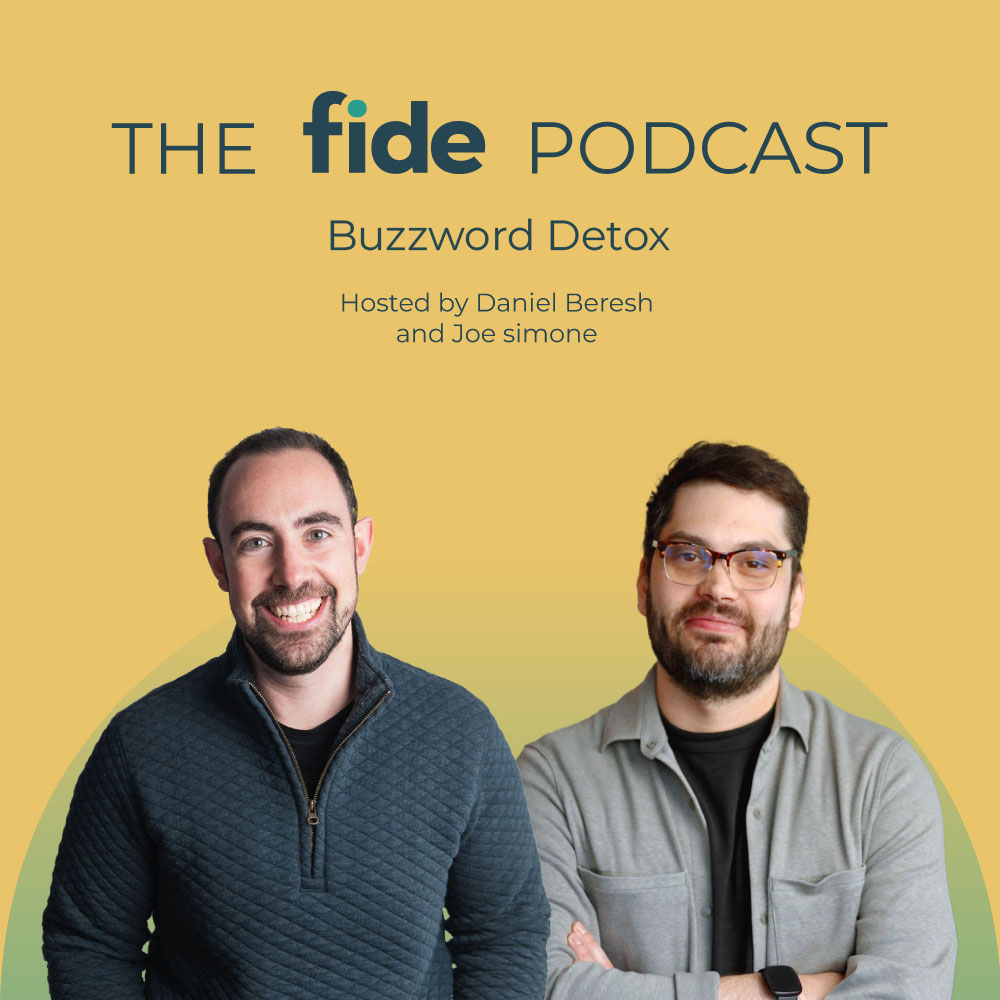
Dan and Joe take a buzzer to the most overused marketing clichés. Kicking things off by unpacking why “AI at the forefront of digital transformation” is more filler than hook. From there, they wade through the swamp of "frictionless, digitally augmented solutions" and the dreaded “value-add activities.” They break down a podcast description, debate whether “innovation” means anything anymore, and find a gem in the phrase “starting from what you have, accelerating from where you are.”
It’s part roast, part workshop, and a reminder that clarity and specificity always outshine the jargon.
Dan Beresh: [00:00:00] Deliver frictionless, digitally augmented global... What? Can't even finish a sentence.
Joe Simone: Hold on a sec. Read that sentence to me again. Today we're talking about buzzwords. A lot of marketers fall into the trap of using them in effort to maybe speed up communication. But in reality, what it ends up doing is diluting your message, and it's really tempting to use.
Dan Beresh: You really sound smart.
Joe Simone: Exactly, but I think clarity is actually gonna sell better.
Dan Beresh: So here's what we're gonna do. We are gonna read each other video scripts, transcripts from websites, little snippets of messaging that big B2B organizations have written, and we're each gonna have a buzzer. So if I'm reading to you, Joe, you got the buzzer in your hand, and when the jargon starts, you hit the buzzer, and we're gonna talk about it.
And we're gonna figure out not only why is it jargon and why isn't it working, but also what would we do differently? What would we do better? Because I think, to your point, it has to be specific, and that is where we start to really fail, is when we get these kind of generic messaging. Now, to be [00:01:00] fair to the people whose videos we are reading, websites we're reading, we're not gonna include any brand names.
If there's a tech partner that's involved that's not responsible for the video, their brand is still gonna be in there. But we're gonna just avoid, you know, calling anyone out because, uh, we know we how hard you work on these videos, and we're just here to have a little fun. So Joe, this is my favorite one here.
Are you ready?
Joe Simone: Mm-hmm.
Dan Beresh: AI is at the forefront of digital transformation, reshaping the way organizations operate and thrive. I say p-
Joe Simone: Sorry, I might have jumped the gun there.
Dan Beresh: Well, well, I mean, reshaping the way organization... My issue is, like, okay, yeah, sure, it's at the forefront of digital. Is- well, i- is it at the, the forefront of digital transformation?
I mean, I guess a lot of the big companies are using it. Uh, just, it's just so obvious.
Joe Simone: I think AI is, is tricky because we've talked about it, and it, I think it is at the forefront, but it is a constantly shifting forefront within AI itself because what, what AI was great at yesterday is totally [00:02:00] different what it is today.
Like, it's moving so fast. That's why I, I took it back because I was thinking reshaping. Well, you know, it is to an extent, so I'll give them that one.
Dan Beresh: Yeah, that's true. I think the challenge, like, all of this, what they're saying so far is true, but we haven't differentiated, and we're through a full sentence.
And you might be saying to us, "Hey, Dan and Joe, you're being so hard on this script," but you have to hook, and I think it's i- the hook has to be the first four to six seconds. It's gotta be in that first sentence, and we have nothing here that makes me feel I'm gonna watch the rest of this, it's gonna give me something different.
Joe Simone: It's kind of telling me something I already know.
Dan Beresh: Yeah, exactly. Okay, here we go. Deliver frictionless, digitally augmented, global... What? God, I didn't even finish a sentence.
Joe Simone: Hold on a sec. Read that, th- that sentence to me again.
Dan Beresh: Deliver frictionless-
Joe Simone: I hate that word.
Dan Beresh: Why?
Joe Simone: Everybody claims frictionless, and it's become so diluted to the point that it has no meaning.
I bet you it isn't true. I bet you [00:03:00] there are some hiccups that happen.
Dan Beresh: Yeah.
Joe Simone: And there's gotta be a better way.
Dan Beresh: It's a good point. Is your client looking at this? This is web copy, by the way. Is, are they reading this web copy and saying, "Oh, absolutely. When I hire this consultancy, they're gonna perfectly deliver a completely frictionless experience"?
I, I don't think anyone actually believes that. Like, we are gonna reduce some friction, sure, and maybe we talk about the areas we are.
Joe Simone: I think that's what I would've liked to have heard about is, like, digitally augmented.
Dan Beresh: Mm. Oh yeah, I love that.
Joe Simone: I mean, it sounds sci-fi, it sounds exciting, but I mean, how are you augmenting?
Well, I, I... Maybe they explain it, so I'll, I'll let you, I'll let you finish.
Dan Beresh: Yeah, that sounds good. Let's see if later on in this copy they're gonna actually deliver on the promise of kind of what they're saying. So, so this first sentence says, "Deliver frictionless, digitally augmented global marketing operations.
Our connected marketing operations solution delivers frictionless, digitally augmented, [00:04:00] data-driven marketing operations that drives a more agile connections and seamless experience with your customers." This is critical in transforming your business, shaping new consumer values, and driving sales. Our next generation digital marketing solutions leverage innovative marketing technologies to enrich your digital strategy with relevant insights and data, maximizing your campaign and channel reach, and drive operational excellence and efficiency across your marketing function.
This drives a range of enhanced business outcomes "
Joe Simone: Leverage innovative marketing technologies to enrich your digital strategy with relevant insights and data." That is the, the meat that I would've liked to have heard earlier.
Dan Beresh: Yeah.
Joe Simone: But it took a while to get there.
Dan Beresh: It's a good point. It's, it's kind of maybe what they're saying here is digitally augmented means you have digital insights, like you have real-time insights that can then be fed back into your marketing to make your marketing better.
Joe Simone: [00:05:00] That's interesting.
Dan Beresh: But the, the problem to me is, like, your marketing operations should already be data-driven, should already be digitally augmented, so what are we really... Where, where's the delta between hiring this consultancy and not?
Joe Simone: What is the tool called?
Dan Beresh: Connected Marketing Operations Solution.
Joe Simone: Maybe I'm being a bit hypocritical here because I'm always about specificity and telling you what it does. The name of the tool does that, but as a marketer, there's no flash or, or it doesn't get me very excited.
Dan Beresh: I don't get excited about Conned- Connected Marketing Operations Solution, and the other problem I have is, is the competition delivering something other than a connected marketing operations solution?
Like, the competition is going to build your martech solution, which means implementing the, the data, uh, you know, and, and bringing that in and giving you the insights that you can use. Like, I understand that some big companies say, "Well, we're not gonna name every solution we have because we've got a million of them, and so we don't want the one to be called Firefly and the next one to be called [00:06:00] Dark Matter."
Fine. It's not, you know, it's not B2C. It's almost like you have one side, which is your more consumer, which is your kind of flashy, fun name, and, and you either pick that, or if your name is gonna be descriptive, the name should be extremely descriptive and say what the thing actually does and the value it delivers.
This is sitting in the middle. It's kind of that, that valley of what are we doing? Um, you know, it's not specific enough, and it's not exciting enough, and so I read this, and frankly, I've kind of already forgotten about, you know, what this is and what this does. Like, I've watched this video or I've read this copy, whatever it is.
I've moved on with my day, and I'm thinking about something that's more memorable.
Joe Simone: Yeah, exactly.
Dan Beresh: Should we go to the next one?
Joe Simone: Let's do it. I wanna read you the About section for a podcast.
Dan Beresh: So it's like trying to get me to, to listen to the podcast.
Joe Simone: Exactly. So after hearing this- All
Dan Beresh: right ...
Joe Simone: you tell me if you would tune in or not.
Dan Beresh: Sounds good. "
Joe Simone: Information is everywhere. For businesses, information is everything. The roles of CIOs, CTOs, and other [00:07:00] transformative leaders impact all areas of business, from employee experience and digital labor to product development and the customer experience. This podcast takes you behind the scenes and screens of today's transformative leaders.
Explore the real-world challenges, inspiring lessons, and practical best practices. From personal transformations to external influences, our host and her guests explore what it truly means to be transformers."
Dan Beresh: I like this.
Joe Simone: I do too.
Dan Beresh: This is actually... It's getting better in the back half as well because it's starting to say, like, go and learn from the real people and the real challenges that are happening, which is such a human thing, and I imagine just empathizing even with people who are in your role is such an incredible value.
If I was a CIO, I think I would probably listen to this podcast.
Joe Simone: I just think it needs to be, uh, reorganized a little bit for clarity's sake.
Dan Beresh: I think the beginning is really tough. "Information is everywhere. For businesses, information is [00:08:00] everything." Like-
Joe Simone: I think what I would like to see is maybe the idea that I think they're getting at is parsing through all of that information and, and using the most relevant and crucial pieces.
It's an information overload. And to businesses, you can't just act on all the information that is there. You have to kind of sift through to the important information.
Dan Beresh: Yes, exactly. And I think if they were to say exactly what you just said, that would be so much more effective. There's so much information everywhere, but you can't go through every bit of it.
So how do you look at what's important, determine what's important, and, and use that to your business advantage?
Joe Simone: Yeah. We hear, "Explore the real-world challenges, inspiring lessons, and practical best practices from personal transformation to external influences."
Dan Beresh: Yeah, exactly. The personal challenges, I think we get back to that kind of empathy thing we were talking about, and understanding how other people have gone through it.
This is why people go and listen to talks at conferences, I think ideally, is to hear it from [00:09:00] the horse's mouth. "I did this thing. This was a big challenge. Here's how I achieved it." So this is a potentially really great, really great podcast. I think, like we talk about this a lot, it comes back to that human, like sell the human thing that you are delivering.
Joe Simone: Mm-hmm.
Dan Beresh: Right? And especially if you're a professional services organization, like sell the fact that you have experts who are gonna come in, who have done this before, who are gonna hold your hand, um, who you can empathize with. Like that is just so much value, in addition to, "Oh yeah, we're gonna accelerate this, and yeah, we can do it in, you know, eight months instead of 12 or 15."
Joe Simone: Yeah, I think it, it gets back to how we try to position our messaging whenever we're creating something. It's so helpful to have that proof point from a person who's done it and/or is doing it to help sell that to someone who is considering that same thing, rather than just talk all buzzwordy and very broadly about it.
Dan Beresh: Yeah, the way, one of the ways, and we haven't truly talked about this, and I think this is [00:10:00] super valuable. One of the ways to get rid of buzzwords or, you know, generic is to talk about the story of someone's success, and it doesn't even have to be a success that, you know, you've had as a company specifically.
Like think about what this podcast is gonna do. This person is gonna interview other folks who are successful in their own right. Maybe they've worked with the host's company, maybe they haven't, doesn't matter. I'm gonna take those stories and use those as fodder for something really interesting. That's how you sell.
I think it really is really what it comes down to. No matter what automation or AI or other system you're using to accelerate content creation, I think you've gotta come back to that human story. Yeah, exactly
Joe Simone: I'm just looking at my notes here. I don't think we ever finished that, um, that first read, so let's revisit it.
This time, let me read it back to you. AI is at the forefront of digital transformation, reshaping the way organizations operate and thrive. SAP-enabled technology-
Dan Beresh: I know digital [00:11:00] transformation is just such a word that people, you know, they understand it, right? It's like, okay, we're gonna come and influence some stuff.
But if there is a professional services organization that can get beyond saying digital transformation and actually talk specifically about what they're transforming and what they're doing, I think that that, that is gonna be the winning, the winning brand.
Joe Simone: Yeah.
Dan Beresh: Because everyone else is, "Oh, digital transformation," and then reshaping the way organizations operate.
Well, yeah, like, that's a transformation. So you've kind of basically told me the same thing twice.
Joe Simone: Okay. Let, let me continue here.
Dan Beresh: Yeah.
Joe Simone: SAP-enabled technology, combined with our innovative suite of transformation solutions, is changing how we deliver value to organizations. Together, we are not just adapting to change, we are leading it, empowering businesses to harness the full potential of AI and technology for sustainable growth and success.
We have been recognized as a top provider of quality AI advice and implementation services, and our AI-enhanced transformation methodology-
Dan Beresh: Can I just stop for a sec- hang on. Okay, we have been [00:12:00] recognized as a top provider of AI implementation?
Joe Simone: How big's the top?
Dan Beresh: Yeah. Uh, are you top 100, top 50? Like, what- Like, uh, we are among people who do this pretty well, is what I'm hearing.
So okay, so I'm gonna, I'm gonna transform my whole business. I'm gonna spend multi-million dollars over what could be, you know, a year and a half plus. I just... There's just gotta be... Like, it, it, it's, it's kind of, it's kind of saying to me, like, "Hey, you know, you're, you're at the kind of regular, you're at the regular store buying, like, you know, cheddar cheese, and, like, you're not really buying the best one.
Um, but you're not buying the craft singles. Um, so, like, it's probably pretty good." I just don't know that that's what people want in this market. And, and good at what? Like, let's be more, let's be more specific. All right, Joe, let's keep going.
Joe Simone: We continue to invest heavily in AI to enhance clients' transformation journeys.
Our AI-powered approach provides deeper data-driven insights- [00:13:00]
Dan Beresh: I'm sorry. What insights are not data-driven? I just feel like insights are, are insights and, and obviously insights need to be backed up by research. I would say something like, you know, we deliver real time insights, if that's true, you know, that, that aren't making you wait two weeks before you get the report from your team, and then you see the data, and then you can act.
Like, the, the main problem here I imagine is you don't have timely insights, and so data-driven insights allow you to make, you know, faster decisions. But it's like, what is the end goal here as opposed to just I'm gonna get some insights?
Joe Simone: Well, they do get into it a little bit after-
Dan Beresh: Okay. Okay ...
Joe Simone: during system and process analysis offers optimized adaptation of project and change management strategies.
So what I gather from that is they're taking the data, seeing what works, and seeing where they need to change. That makes sense to me.
Dan Beresh: Yeah. Okay. That's fair. So you are using AI to adapt the way that the project is being [00:14:00] run. It's gonna run faster. It's gonna run smoother. To be honest, I, I would personally prefer if they just said, like, that in that kind of plain language.
I, I think plain language is just so underrated.
Joe Simone: Actually-
Dan Beresh: Okay ...
Joe Simone: speak of the devil Yeah. Let's, let's- Offers optimized adaptation of project and change management strategies, automates testing and migration tasks for faster implementation- Hmm ... and generates comprehensive and tailored documentation to allow more time for value adding activities.
What are those activities, please? And ultimately help drive a smarter transformation journey.
Dan Beresh: Yeah. What are those activities? And also, I hate to say it, but I- we have seen lots of AI implementation in the tech development space. Mm-hmm. Automated testing and documentation is not a differentiator. W- what are you doing...
I-- what I wanna hear is what are you doing specifically with that that kind of goes above and beyond? And talk to me specifically about what you can You know what you can do. I suppose y- you know, if this is an enterprise company, [00:15:00] basically what they're doing with this is they're rising above the SMB level that doesn't have that AI capability.
They can't invest in it. But they're not differentiating against a, a, like a big four consultancy with this language, I don't think.
Joe Simone: No. And the, the value add activities from speaking with our clients, when we ask them really drill down into what that means, it's usually spending more time with clients solving more problems.
We can get more done, and I'd rather hear that than value add activities.
Dan Beresh: Eas- yeah, and the more we use AI, the more people are gonna have to be in a role where they face other people and they deliver value through an understanding- Yeah ... and of really white glove service. That's the kind of thing that I think could be super valuable to talk about that we are absolutely glazing over here.
And frankly, we're, we're a little bit obsessed with features and not benefits. And I, I think it's gotta be, and this is kind of, uh, maybe a different [00:16:00] way of saying what you're saying, Joe, the benefit sh- has to be a benefit to the client. What does the client get?
Joe Simone: What's in it for them?
Dan Beresh: Exactly. Because if I'm paying 5 million bucks for small transformation, let's say, and you are gonna deliver to me code that's tested and compliant and all of that, do I care if it's been done with AI, or is actually, uh, the AI system hopefully just saving you internally money and maybe giving you a bit of a higher margin?
AI, I mean, we come back to this so many times, but it's like AI is the feature, not the benefit.
Joe Simone: Right. I'll just skip ahead to their last line here. Let's see how we're closed out. "Experience a transformation journey like never before where AI amplifies human expertise at every step, delivering faster, more precise, and truly innovative outcomes.
Transform your business with confidence with us and SAP. Connect with us today to get started."
Dan Beresh: I really hung up on truly innovative outcomes. I could kind of see the creative room where the writer's written, "We can deliver [00:17:00] innovative outcomes," and someone says, "Well, yeah, but everyone else can deliver innovative outcomes.
What should... Oh, well, well, truly innovative outcomes." That's-
Joe Simone: I take umbrage with the word innovative itself.
Dan Beresh: Yeah.
Joe Simone: It's kind of an Ouroboros at this point. It's eating its own tail. Everybody is using innovative, and it's not innovative at all, and it doesn't say anything other than, "Trust us. We're cool. We have new ideas."
Dan Beresh: Yeah. Yeah, it, it... That really is it, isn't it? "Trust us, we're cool." The, the, I think the problem with these words, even though some of these words do have meaning and could be valuable, but because they've kind of been overused by everyone in the market, the value is lost. And if we come back to what things mean, like innovative, innovative means, uh, to, to innovate, which means something new, uh, genuinely new.
A- a- and I think a... To be honest, a lot of the time with digital transformation, w- what I've heard from clients is, uh, and not being our clients, th- these consultancies saying, "You know, you don't want to reinvent the wheel every time with a digital transformation."
Joe Simone: No, you wanna make sure it works. [00:18:00]
Dan Beresh: Yeah, use the best practice that's been tested across everyone else in your vertical.
Exactly. So that's actually the opposite of innovation, which has its own advantage. We all just wanna say innovative for the sake of saying innovative. It's exactly what you're saying, Joe. It's, it's comes back to like, let's use the cool word 'cause it sounds, sounds great- Yep ... and everyone's gonna think, "Oh my God, this is amazing."
Joe Simone: Back to what we said at the top, it just dilutes the clarity of your message.
Dan Beresh: 100% it does.
Joe Simone: Okay. We'll, we'll table that one there.
Dan Beresh: Sounds good. Uh, all right, I got one for you, Joe. Are you ready?
Joe Simone: Okay. Yeah. Here
Dan Beresh: we go. This is a little, this is a bit of a shorter one. I kinda like this one 'cause it's, uh, it's really out there.
It kinda gets me excited. Let's see how you react to it. "We're on a super highway to progress, built on flexibility and security, empowering you to achieve more. Starting with what you have, accelerating from where you are, fueled by the brightest minds and the right technology." Let's partner to power your progress together.
Joe Simone: I wish I had a happy buzzer sound [00:19:00] because there was a line in there that I actually really liked. Starting from what you have-
Dan Beresh: Accelerating from where you are.
Joe Simone: I like that.
Dan Beresh: Yeah.
Joe Simone: What they're saying is We're not starting net new. We're meeting you from where you are at currently, and we are gonna go forward from there together.
And with us, it's gonna accelerate the progress. It's... I like the way that they framed that
Dan Beresh: I think there's an anxiety around maybe should we be further ahead? Should we have, for example, adopted AI in a different way? And are we, you know, what, what's, what's happening? Is our legacy system holding us back?
And it's almost like saying to them, "Hey, wherever you are, it's okay. Like, we are gonna hold your hand and help you to, to guide you."
Joe Simone: Mm-hmm.
Dan Beresh: I think there's a really underrated element of, of B2B marketing, which is just there's so much worry, for very good reason, I think- Yeah ... 'cause there's so many millions of dollars at stake.
And, and in, and without saying, "We're gonna hold your hand," 'cause [00:20:00] that could feel maybe a little bit trite, uh, y- you're right, I think they've re- achieved a really nice way of, of saying that.
Joe Simone: That's one of the things that, uh, you mentioned to me a while ago, uh, about the nature of consultancy. Like, it is nice to have a guide.
It is nice to be met where you are, and then somebody just guides you with their expertise. That's a great thing to have.
Dan Beresh: It's a beautiful thing, and it allows you to have that external validation, which I think is so important. I was working at one of the big banks years ago, and, uh, my boss would complain about the fact that they brought in these big consultants, expensive consultants to tell them exactly what they already knew.
Mm. And I think what he didn't understand is there's so much value to that validation from someone who has seen the market, who understands, who has worked for competitors, and who can say, "This, yes, this is best practice. Yes, this is the right direction," so.
Joe Simone: So this was a little bit different than what we normally do, but I think it was a [00:21:00] little bit of fun.
It was a good thought exercise for myself. I don't know about you, Dan.
Dan Beresh: Yeah, 100% it was. I think it's important to take a step back from the things that you're writing and, and really have the ability to put yourself in the client's shoes and say, "What are they gonna understand here?" That's something we always try to do with our, our work.
Um, and certainly it's a lot easier for us to critique stuff after the fact. I'm sure that a ton of work went into this, and hope we didn't offend you if you're part of the, uh, the creation teams on any of these videos. But I think on the whole, the, the lesson for me, Joe, is be specific, even if it takes you a little bit longer to say it.
And don't think that you're sounding super smart if you use these buzzwords. It's just, it's actually kind of the opposite when it comes down to-
Joe Simone: Yeah. I think your end goal should be, like you said, specificity, and at the end of the day, it's clarity. I want to make sure my audience understands what it is I'm offering
Dan Beresh: Yeah
Joe Simone: and how it helps them and how it benefits them. And [00:22:00] unfortunately, if we try to condense all of that into a lot of snappy buzzwords, a lot of that clarity can get lost.
Dan Beresh: I'm here to say if you think you have to compress your writing into, you know, a certain length, and as a result you've gotta use these buzzwords that are gonna get you kind of over the hump to say five things or six things in one, you're not gonna say any of those five things specifically.
So I think come back to what you can say clearly within a certain amount of, you know, predefined time if you have that. Don't take the easy way out. The easy way is buzzword jargon, we help, we create value, transformative value, all of these things. Be specific about what you're doing, and, and even if you have to create something that is broad about a, you know, enterprise organization that can kind of help anyone everywhere, there's gotta be a USP you can include there that is gonna make you different.
If you can read your script with a competitor's name in it and it still [00:23:00] works, you have a problem, I think.
Joe Simone: Big time.
Dan Beresh: Thanks for listening, everyone. We'll see you next time.
