
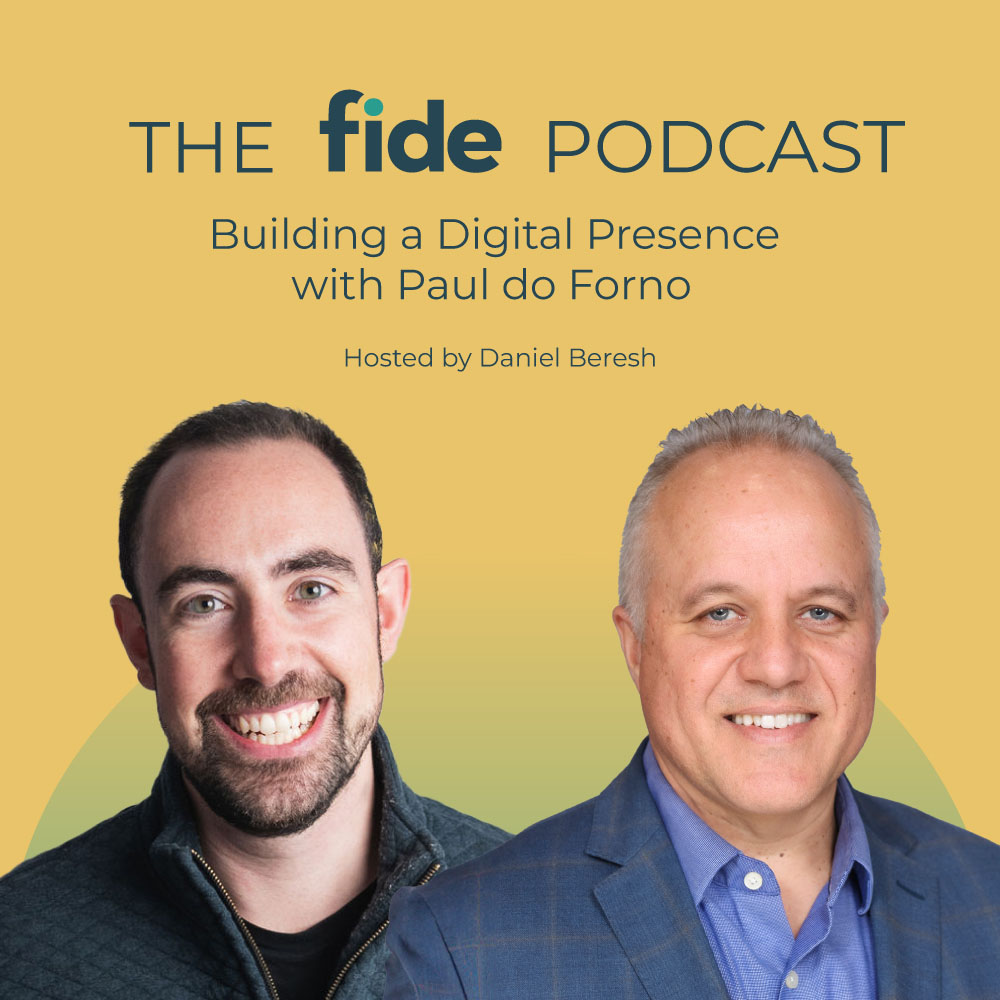

Paul do Forno, partner at Deloitte Digital, shares his insights on how to get yourself out there online to build your authority in the market. He emphasizes the importance of having a digital mindset, being consistent in your digital presence, and leveraging partnerships with technology and ecosystem partners. Paul also highlights the significance of focusing on making your clients successful and connecting all the dots in your area of expertise.
Keywords
consulting marketing, go to market, digital mindset, consistency, partnerships, client success
Takeaways
Dan Beresh: [00:00:00] If you've ever been curious about using platforms like LinkedIn to build your personal brand, fill your sales pipeline, and ultimately grow your career, this is the episode for you. This is the Fide Podcast. It's the podcast about going to market as a consultant. And today, I'm really excited to have Paul Do Forno on, an absolute expert getting out there online.
Paul, can you tell the folks a little bit about yourself before we dive in?
Paul do Forno: Sure. I am a leader partner at Deloitte Digital. I lead up our B2B commerce practice, and I've been doing digital and commerce for over 25 years, and in the last 20 years, I've, I've sat on the advisory board of every major e-commerce, uh, enterprise product, including many of the in ecosystem.
Dan Beresh: That's why I'm so excited to have you here is you are an expert at commerce, and I'm so interested to hear from you today how [00:01:00] you think about commerce, uh, for the products and services that you actually go to market with. So on the Fide Podcast, we always start with three actionable takeaways, uh, and then let's dive into each one of those individually in a conversation.
So Paul, what... If you were to give someone advice about how to do consulting marketing, how to go to market, what would be your top three tips?
Paul do Forno: Number one, be digital and have a digital mindset, and be consistent at it. Number two is look for the partnerships, the technology partners, the ecosystem partners that you can get a win-win out of what you're trying to achieve. And lastly, and most important in all these, in the area that you're passionate about, how do you make your client or your customer successful in that space?
Dan Beresh: I'm, I'm so excited about talking about being digital with you. We had a good chat, uh, a couple of days ago about LinkedIn, and one of the reasons I'm so excited to have [00:02:00] you on the podcast is you are one of the few people who is so incredibly consistent with your LinkedIn posting.
You're always posting interesting articles about this, about that. So let's unpack that. Let's start there. What does it mean to be digital?
Paul do Forno: I think one of the things of getting out there, and a lot of people might have a LinkedIn profile, and they might have put some effort into it. But i- in the modern day, your LinkedIn, your Twitter, you know, doing podcasts, th- this might be the first way that people find out about you or learn about you or your services or the company that you're at.
And so the more that you can be out there, the better. And I'll, I think a lot of times people get overwhelmed and think, "Oh my God, I have to do-- I have to write a massive 500-page white paper, or I have to do something massive to, you know, get published, to be different." And in fact, you know, just being out there and having a pulse out there.
And so what I've learned from some of the smartest guys out there in [00:03:00] many ways is being consistent and sharing stuff that you find interesting on a consistent basis, it's amazing what those do. And so you don't always have to have a hundred-page dissertation to get out there, but like, "Hey, I found an article that's interesting." Great. Push. So, so that's, that's the premise.
Dan Beresh: I was just thinking, you know, in some ways it's, it's even more interesting to have just a little snippet or have an article.
Paul do Forno: Right.
Dan Beresh: Cause who wants to read your hundred-page dissertation, especially if they don't know you, right?
Paul do Forno: Ex-exactly. And, and in fact, think about the benefits of exercising for a body.
The more that you can do, like, on a consistent basis throughout the week and get into a routine, you, you get huge payback. In the same way, you can build your digital footprint by, like, "Great, I have a goal of sharing 12 things a week, two on the, on the weekdays and one, uh, on the weekend." And, and I have tools, and I have-- and I read a lot of stories.
And so a lot when I go to sift through lots of these [00:04:00] channels, I sign up for newsletters. And all of that I learn, you get a really better sense of a pulse of what's going on in your marketplace, your competitors. But then also, if you just share, "Hey, I think this is..." I've now gotten to the point where I read lots of stuff.
If it's not interesting to me, then I'm not sharing. If it's interesting to me, boom- then I, it'll be interesting to somebody. And my goal, and what I've seen, is that people aren't gonna remember that, that one thing. They might happen to remember one thing, but it might be like, "Man, that guy's always sharing," right?
And it seems like I'm always there, and you can... It doesn't mean you're doing this all day. You can schedule posts. You can do all those things. So that's, that's the baseline of what I've tried to do as, one, keeping up with the industry and, and understanding. And anybody can do this. Anybody. You can do it.
So there's no excuse, right? So this is, like, anybody can do this.
Dan Beresh: I love that. It's just like the gym.
Paul do Forno: Yeah.
Dan Beresh: It's so easy to make [00:05:00] the excuse to not do it, and I think that there's a fear, and I think in some ways rightly placed. We have this fear put in us even in grade school, "Oh, don't say this, don't say that. People aren't gonna like it."
But these days, to me, being digital, putting yourself out on LinkedIn, if I see you post or someone else post an article that is not specifically interesting to me, then I move on and I don't have to click on it, right? I'm not thinking, "Oh, wow, that guy posts a lot of articles that I, you know, that I don't really, I'm not really that interested in."
And I think that the more you do it, and I love this gym metaphor 'cause it- it's like a muscle-
Paul do Forno: Right ...
Dan Beresh: and it builds, and it becomes easier every time.
Paul do Forno: So and this is kind of the base. The other thing, the, the other related area about your digital, I say yes to everything as far as if there's an opportunity to present at a conference, at a, on a podcast, on a webinar, yes.
It's not like I'm the smartest guy in this, but I'm the guy who continues to try and, and put [00:06:00] stuff out there, and then I learn. Like, there, there's a learning process that goes out there. So the more that you do it, you get a little bit better, and so you get comfortable, and you get over- a, a lot of it. And if you're passionate about a, a topic, then it naturally kind of gets better and better.
And I'm actually also starting to write more, so write, um, myself and write more content. And so all of this stuff is kind of intertwined, and I think that helps you be a better consultant. One, you're driving more awareness. Two, you're keeping a pulse and you're being connected. And three, you're getting the confidence to talk and be on the topic area that you wanna be an expert on.
Dan Beresh: You have to have that confidence because otherwise, otherwise you're not an expert, right? And the other thing I love about this writing and just putting yourself out there and, and being on these platforms like LinkedIn is you're having to talk to a, a public audience. And one of the things that we see a lot in the work I do is we work with consultants [00:07:00] who speak to folks who are inside of their own organizations a lot, and there becomes a bit of an in-group and a speak that is, that is consistent with that in-group.
The, the old, you know, consulting phrase is the 30,000-foot view, the treetop, you know, boiling the ocean, check what's in the sandbox. I mean, we could go on, right? But I think that by putting yourself out there in the public, you kind of inevitably start to think, "Well, hang on, I'm speaking to this different audience."
And that gives you practice at communicating to folks who, you know, could be your clients in a way that is, is clear and effective, uh, rather than just this bit of an echo chamber of, of staying inside your own organization.
Paul do Forno: Yeah. A- a- absolutely. And you get to know all the experts in the area, like people that like to write and that, and it's a whole other group.
And so I can't tell you how many connections I've made and sales I've actually done just because I, I've been out there.
Dan Beresh: So how does that work? I mean, for those people listening, I'm sure they're so curious. You, you, you post consistently and someone [00:08:00] says, "Hey, Paul, saw you posted this. Really love it. I actually have this problem that's related. Can we talk about it?" I mean, what was that journey like?
Paul do Forno: Sometimes it's that, it's that straightforward, or it may be, which is a good segue to our number two, how do you partner, right? Like, and so especially in the enterprise, like many companies, I've spent my whole career selling to the enterprise, and selling to the enterprise is a long process.
And so a way to really connect is how do you partner with key technology partners, like the big platforms of the world out there that are selling and marketing, and also some of the smaller ecosystem players. And so they spend a lot of time, so why go on your own, you know? Get a group together and work, and how do you do a win-win?
The more that you can find win-wins, it makes your sales cycle smaller. I've had incredible success in focusing on key partners [00:09:00] that, um, part of the messaging is how do we help each other? Right? And, and how do we get into those discussions? Because they might be doing some marketing pieces, or they may be hosting a dinner that you can speak to.
They might have some of the investment and also connecting the dots that'll help tell the story. So always try and find the partner win-win.
Dan Beresh: We do that as an agency. I have agency partners that we work with when we know that we have a gap somewhere, and they can come in and fill that gap in a way that we don't have the capability, we don't have the expertise in that domain.
And I think when we talk to our clients, uh, you know, the, I think the fear in our world is, "Oh, well, there's another, there's another partner involved, so they're, you know, they're gonna steal our business." But if you have that trusted relationship with your client, and you explain to them, "This is actually way better for you because you're gonna get the best, the cutting edge of whatever that partner is bringing, plus what we're able to bring, our [00:10:00] deep knowledge of your, of your business," I think they're appreciative of it and, um, and, and go to market together.
Paul do Forno: Yeah, especially the technology, 'cause the technology, they s- they have way more marketing, right? Like, the tech players have so much more marketing than consultants do, and they have a whole sales force that they're reaching out. But many times they don't have the insights of, "I've been there, done that. I've had to implement it. I've had to work with the..."
And so the, the value that I can bring is the experience to actually make that transformation and help them. And so it's kind of a win-win. A- and so again, build your digital footprint, work with others to partner so you're not, you never go alone. And this is something within consulting, this partnering, it's not just the partnering with external vendors, but, like, how do we work with a win-win within a large matrixed organization?
Like, how do we bring the best of an industry expert with a commerce expert, with a supply chain expert, and coming [00:11:00] all together? And so again, if you're a lone wolf, you're not gonna be successful in the long term. It's how do you bring the, those partnerships together?
Dan Beresh: If you wanna go far, go together.
Paul do Forno: Exactly.
Dan Beresh: So- I imagine, though, that if you're looking at a big technology partner, that those big technology partners are also looking at your competition, and must there not be in someone's mind who's thinking, "Okay, I'd like to partner with these folks, but how do I know they're gonna have my back and not go to the next big, you know, consulting player or systems integrator and work with them?"
Paul do Forno: So I, uh, there's a couple of things. So number one, if you're known as an expert, then you're gonna add value. You're gonna add credibility to them. And so in many ways, a l- lot of these partners, they struggle with, "Are you just trying to sell me something?" Right? A- and a, a little bit on the consulting side, and this is part of what we have to balance, is yes, we're trying to sell, but you can only sell if you are clearly articulating the value you're gonna [00:12:00] drive, how you're gonna help the client.
In many ways, that's what they struggle with. And in fact, and I, I would never wanna be a, a salesperson for a software company because the pressures that they have. I'm there for the long term a- and so I don't have the same pressures of selling quarter to quarter to quarter. And, and so I can be that, more of that- A independent expert to help them.
Dan Beresh: And, and in that way, you do very much see the symbiotic relationship, which I think exists so much. When it comes to marketing, though, Paul, you were talking about them having advertising dollars. Mm-hmm. How do you leverage that for your own, you know, benefit really a- as a consultant?
Paul do Forno: Well, because I'm, I'm active, I will-- I get asked a lot, um, to be out there because, again, I'm, I'm, I'm approaching close to 15,000 LinkedIn followers, and if you...
Close to 5,000 Twitter followers. And, and I, I was even part of, you know, some of these new social networks that were out there that are, [00:13:00] are really trying to connect with people. So I've... And I'm known in the industry, and so for them, there's a, there's a value there. A- and so I, I, I try and reach out and tell that story, um, and because they, they understand that, it helps them connect, but also that independence.
Dan Beresh: They know that you're an expert. They know what you're doing, and they want to partner with you because you've established that. And kind of to your earlier point, you gotta show up first, be consistent, and, and maybe in-- make a name for yourself.
Paul do Forno: And pa- and part of th- th- that first part of the digital thing, I read so much about what I share.
A lot of that comes back, like, when we're having these discussions, I, I can pull from, "Well, I, I know that research that was just done," or, "This case that happened in B2C or this other case." It, it all kinda helps you, so-
Dan Beresh: Makes you the expert.
Paul do Forno: Yeah. It's not just, it's not just marketing to share that. You're learning, and you can quote that, right?
So you're in... It, it's kind of required homework, so why not [00:14:00] do that homework in public so that you get some of that benefit of connecting the dots?
Dan Beresh: Yeah. And, and then to your point, you're not going out with some vacuous marketing message that is just, "Hey, buy my product." It's, "Hey, I am actually an expert, and I am actually gonna be able to help you in this way."
Paul do Forno: and, "Here's some learnings, and if it's beneficial, we might not do business now, but down the road, I can help you."
Dan Beresh: And that long-term non-transactional play, building relationships, I, I think is so, so incredibly important. Let's talk about your third item, Paul.
Paul do Forno: So the third, and most importantly, all of this as a consultant, is you have to focus on how this digitally and your partnerships are gonna bring value and make it easier for your customers And how is that gonna benefit them?
And so because I've worked with a lot of different partners, I can be a little bit more balanced, right? If, if you can imagine how many clients get inundated by every ecosystem [00:15:00] partner and they just say, "Hey, they're the best." I can provide a balanced opinion and a balanced discussion, uh, with them to help them.
But then importantly, I look at ways that not only to make them successful as a company, but especially in the enterprise, one of the areas that really makes a difference is if your job's on the line, that's where we really help because I'm, I'm gonna be there to make sure you're successful and you're gonna get promoted.
And so that's really the differentiator for high-end, um, relational selling that you can make that difference. You bring the specialty area expertise, you know how to work with the different partners, and you can bring those things together so that your client's successful and that they're gonna get promoted.
And that's something that over the last just couple years, I'm so proud that many of my clients have been promoted and I've personally made them successful. And what actually [00:16:00] matters is, again, going back to number one, is it's so many of the, the little things, always being there just that they know that they can trust.
It's not about necessarily the big, huge things. It's a lot of more that consistency and the trust that, that they know that you're gonna be there and you're there for them.
Dan Beresh: And you're there for the long term and you genuinely care about their personal success.
Paul do Forno: Yep.
Dan Beresh: But you can't, you can't just go to someone and say, "Hey, listen, I, I'll do this digital transformation for you. You're totally gonna get promoted if you hire me."
No. I mean, that sounds so salesy, right? So is there a way that you communicate that to people? Is that more of an implicit thing? Do you talk about past success? What do you do?
Paul do Forno: Yeah. Obviously to start with, you really kind of try and share your own stories to help you credentialize and say, you know, "Here's the types of experience that I've had with other clients and how they've been successful and how they've been helped."
And again, try and make it positive, but not over salesy. Like again, in [00:17:00] each situation, try and understand how to help them be successful in that meeting. So in an initial meeting, they might just wanna know, "Hey, I'm thinking about these couple platforms, like help me narrow this down." And then different ones like, "Hey, I gotta drive this net new revenue.
How do I talk to my CEO and t- do a business case?" Like you, you really have to understand and listen like what are the things that is important to them today, not way down the road. Like you know, really the more that you can listen and then that consistency builds a relationship where then it becomes apparent, you know, building those long-term relationships.
There's no easy way. It's like how do you build a digital presence? Like, it's, you know, start simple and consistently day after day.
Dan Beresh: That's something that I'm hearing from you, and I think is maybe a theme in our conversation today, is just being consistent-
Paul do Forno: Yep ...
Dan Beresh: showing up, having the courage, uh, to do it, and the [00:18:00] conviction to keep going.
And look, if, if you just do little steps at a time, even if it's not the perfect thing on day one, that you will get better, and that a year down the road you're gonna see real change.
Paul do Forno: Yeah, absolutely. I, I'm not the best consultant out there. I'm not the, the smartest guy in this. I, I just put in the effort, right?
And, and anybody can do this, right? Like, you know, pick your spot, and there's no easy game. Like, you see on some of these socials, like, "Here's the seven steps, and you're instantly gonna be successful." Like, it's really hard, just like, uh, in the gym, right? It, it's easy to say, "this is what you need to do," but you really just have to, you know, put in the time and the focus.
You know, pick an area that you wanna be known for in digital. Focus on, uh, the platforms and the, that you can partner with, and all of those for the service of your clients. That, that's what's been my [00:19:00] combination of success, and I think really any consultant can leverage and, and be successful that way.
Dan Beresh: Paul, I wanna let you go in just a second here, but I, I'm just so curious. We all have days we don't wanna go to the gym. What about those days where you just don't want to show up? You, you just think, "Man, I've been doing this for so long. I'm not seeing the results I thought I would." How do you motivate yourself personally?
Would you have any s- tips to share?
Paul do Forno: It, you know, it, sometimes it, it, it does get hard, and, uh, I, I think the more of, like, just being curious. Find your topic area, and even if it's not, if it's boring and it, and you've done it again, share that or talk about it or engage with some people and give feedback.
The, the other thing that I've done just to keep when I might be not fully engaged, you know, I try and be super positive to all the creators because it's hard to create new content. And so I've gotten to know them, so when I can, I try to give them positive reaffirmations, right? Because, like, it's hard to be a creator.
And [00:20:00] I, I don't do it full time. I'm, this is just my part-time thing and my normal gig, but, like, those creators that are out there getting paid just as creators, that's a hard gig. And so I, I try and, like, get it, uh, motivated by looking at some of those guys and like, how the heck do they do it?
Dan Beresh: That's the hardest job in the world.
Paul do Forno: Mm-hmm.
Dan Beresh: What are you gonna put out next? Yeah. And you're only as good as what you did last month.
Paul do Forno: Absolutely. So I, I give all the, uh, y- you know, so much respect to those guys.
Dan Beresh: Well, Paul, thank you so much for coming on today. Thank you so much for the tips. This has been absolutely incredible, uh, and I'm so excited to share this episode with the world, so, uh, I can't thank you enough.
Paul do Forno: Thanks, Dan.
Dan Beresh: Thanks, Paul. This has been another episode of the Fide Podcast. Thank you so much for listening. I hope you got a lot of value from today's episode. I hope there's something that you're gonna take away and implement in your day-to-day life, and if not, I hope that at least you're inspired to put yourself out there, to get out onto LinkedIn, and to say, "You know what? I'm just gonna start. I'm gonna do it. I'm gonna be [00:21:00] as consistent as I can with the time that I have."
If you need help, we're here to help. We are the agency purpose-built to help consultants go to market. Please feel free to reach out to us. Check out our website, fidecreative.com, and there you can contact us and figure out a little bit more about exactly what we do.
Until next time, all the best.
