
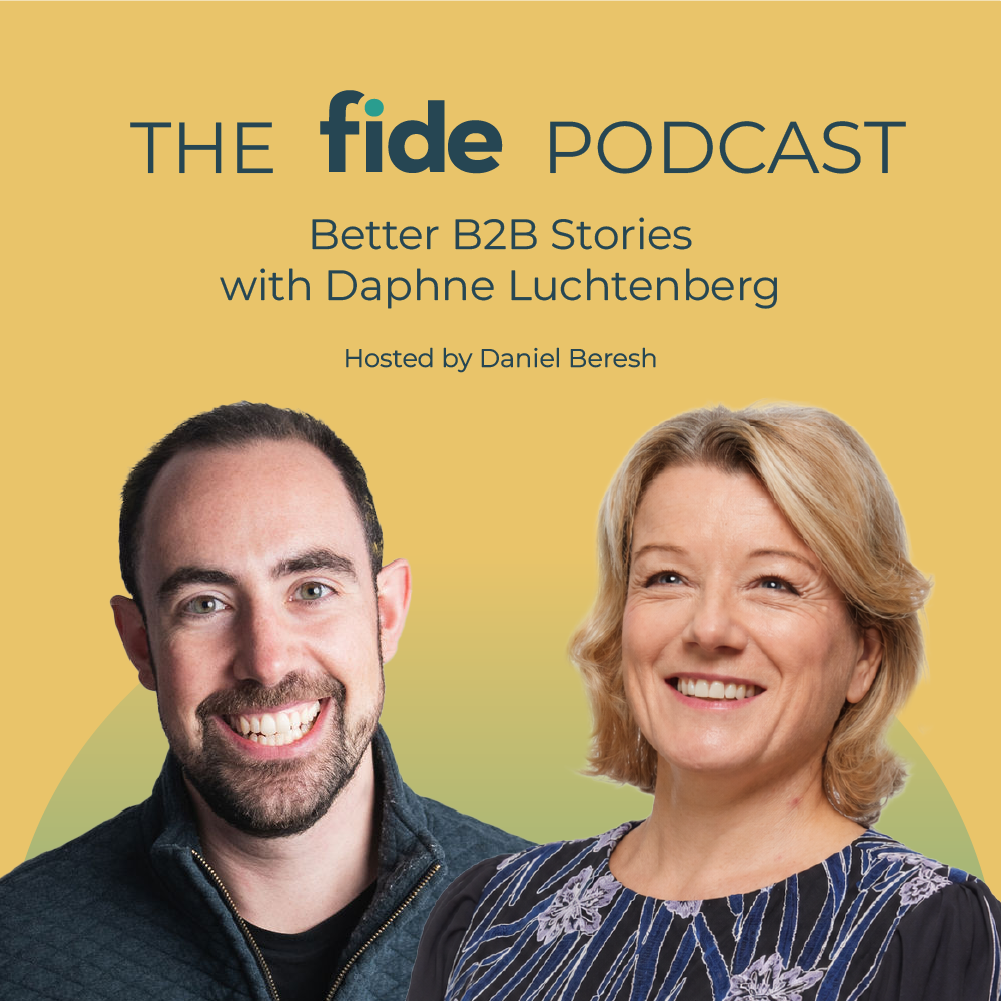
In this episode of the Fide Podcast, Dan Beresh speaks with Daphne Luchtenberg, Global Marketing Director for McKinsey Operations Consulting, about what makes B2B marketing and client storytelling actually work. Daphne shares why the fundamentals of B2B marketing still matter: clear value propositions, deep audience understanding, emotional relevance, strong brand trust, and content that helps buyers see what is possible.
The conversation explores how professional services firms can move beyond features and proof points to tell more compelling client stories, why the client should always be the hero, and how AI can support marketers without replacing the human relationships at the center of complex B2B sales.
A practical conversation for B2B marketers, communications leaders, consultants, and professional services teams looking to create stronger stories, sharper thought leadership, and more effective go-to-market communications.
Dan Beresh: [00:00:00] Welcome back to the Fide Podcast. I'm Dan Beresh, founder of Fide, and today I have Daphne Luchtenberg with me. She is the Global Communications Director at McKinsey's Operations Practice, but she's also had so much more experience before that working at EY, at Visa, a- a- and other places, and is really truly an expert, in B2B marketing and communications.
Daphne, I'm so excited to chat with you today.
Daphne Luchtenberg: Oh, thanks for having me, Daniel. I'm not sure I am the expert, but I certainly have had a lot of chance to play. there's, there's things I can share for sure. Nice to be talking to you.
Dan Beresh: It, it's such an interesting, world I think we're in right now in terms of where B2B marketing is at.
There's a lot of talk about how B2B marketing is shifting and, in our kinda chats leading up to this recording, we talked about your experience in B2B marketing and communications, and really having started that, in a way and, and really been at the beginning, form- formative years shall we say, of B2B marketing.
And one of the things I thought would be really interesting to chat with you about is- We talk about things changing, [00:01:00] right? and so often we talk about, oh, everything, the pace of change, it's so fast, and yet there are these fundamentals, I believe, that, that tend to stay the same. And so I'm curious, why don't we start there, Daphne?
what's your perspective? How did... Tell me a little bit about the beginnings of B2B marketing and what's shifted since then what's not.
Daphne Luchtenberg: No, I love that question. actually, I started out always thinking that I wanted to do marketing, and so I did a communications degree. within that communications degree, there was a very basic, foundational course that was around, marketing, and we talked about the four Ps and all of those things.
And then, my first job was really, working in administration, quite frankly. I was like the office junior, helping anybody who needed either photocopying or the phone answered or coffee-making. and I knew that at some point my marketing skills would come to the fore, but basically it was just learning about business in that context.
and my first real marketing job, I would say, was when I came to London and I started [00:02:00] working actually for a small consulting startup. and that was so formative because it was B2B marketing. We were selling a new consulting service to, to business decision-makers who even at that point didn't know that what they needed was internal com- communications consulting, right?
So not only were we kicking off a new consultancy with a new value proposition, we were actually, and obviously I was part, a small part of a cog of a, of a group of 20 folks who had a vision, really putting internal communications on the map. and so B2B marketing from scratch. Building your own database, building your own value proposition, creating a network of people that you needed to engage with, understanding how you could engage them.
and then, even then we, we coined and created our first book, just to definitively put the value proposition of internal communications on the map. And I [00:03:00] learnt so much, and all of those fundaments Are fundaments that are still absolutely core to the conversations I'm having today with our senior partners at McKinsey about how we make sure that they extend their reach, they seem relevant, and that build and deepen their relationships with their clients.
Exactly the same fundamentals.
Dan Beresh: Which is the ability to identify the folks that you want to-
Daphne Luchtenberg: Yeah. What's your value proposition, right? What's your value proposition? Who needs it? Do they know about you? do you know them? Have you got, interesting, engaging content that can help you start a conversation?
Are you tracking that? how do and then how does the sales function and the commercial function come in? How do you build that towards advocacy? How do you get those folks who have enjoyed working with you now, help you build your brand? those are still exactly the same things that we're doing now.
Dan Beresh: I think it's really interesting to hear you [00:04:00] talk about that even building for the value proposition from the very beginning, and I think that that's still such a s- a struggle with a number of our clients and folks we're seeing in the market. You've built a business, and the business is built, i- inside out in a lot of ways.
We- we've figured out how the departments should be structured based on the skills that people have, not based on how we need to go to market. And so then when we try to go to market, with these kind of individual, for example, service lines, it, it can feel very, I think, disjointed from the client side.
And I don't know if you'd agree with this, but what we see, I think, a lot is, companies just really struggling to Connect with that, that, that buyer because- they haven't necessarily gone out and done the research. I think we tend to make a lot of assumptions, and we say, the business is running well, so why would we need to change anything?"
And it's, often we're coming in and saying, to get to that next level, it's really about being a little bit more outside in, about understanding that buyer, where they are, and how to engage with them."
Daphne Luchtenberg: I think that's right. And I think, certainly as you're in the growth phase, often things happen through [00:05:00] momentum, through accident, right?
Through energy, through, happenstance. and then over time what you come to realize is what's resonating and what's not resonating. And then you realize, actually I could just keep going in this organic fashion, or in fact, if I'm really keen to scale and grow, I need to get into a position of being able to codify what I'm doing, what is distinctive, and what does the buyer get from that.
and don't you often have conversations where you're saying to folks, "What you're describing to me is a feature. What you need to tell me is what's the benefit?" Every
Dan Beresh: day.
Daphne Luchtenberg: Yes.
Dan Beresh: I had a conversation yesterday where they said, the technical rigor is the benefit."
Daphne Luchtenberg: Why?
Dan Beresh: And... exactly, right?
And, but the technical rigor, to me, the technical rigor could be just right next to the benefit, right? Because the technical rigor provides the benefit, which ultimately creates a differentiation for you in the market. But I think that there is a real, a, it's a real challenge for people to understand [00:06:00] that thing that they think is valuable...
and in truth, features, in my opinion, features are valuable, but they're not necessarily the front door-
Daphne Luchtenberg: Yeah ...
Dan Beresh: to selling a good or service. It's not
Daphne Luchtenberg: necessarily what you need to communicate. Exactly, right? yeah.
Dan Beresh: Exactly. Yeah. And, and the communication, I think it can sometimes just need the tiniest little shift- It's not you're doing absolutely everything wrong and your communication is totally flawed.
frankly, you probably wouldn't have a business if that was the case. But how can we as communicators help you to just get to that next level with small little changes here and there?
Daphne Luchtenberg: Yeah. and, and, and the other thing, Daniel, I think certainly, it takes a little while in B2B to get people to realize that emotional need is as important as the actual product and technical specifications of a service or a product, right?
what's the emotional need you need to tap into? And in fact, I was, in a session only a couple of weeks ago when we were talking about where do sales processes fail, right? and there was a key insight that sales [00:07:00] processes fail because the salespeople don't, anticipate what some of the risk factors are that the buyer- needs to contend with, and those risk factors may actually have nothing to do with the specific product or service in the specific function that you're selling, but may be a wider contextual piece that you may never have realized was in play because you've never asked the right questions. and so this emotional need, right?
What's the emotional need or what's the emot- emotional barrier that is stopping you from progressing the conversation? that's often about asking questions, and if you only have a limited amount of time with your, with your target audience, you tend to want to fill it with lots of information as opposed to using it to gather more information.
Dan Beresh: And I think in a B2C context, you might take a weight loss or a beauty product and say, "Okay, we can speak to the emotional need there," and that could be a relatively one-to-one or relatively clear, how we're gonna speak to that. When we start to [00:08:00] c- commit to selling these buying committees of, several individuals, all of whom potentially are in different parts of the organization and therefore care about different things, I think the emotional end of that becomes much more difficult.
And so what's the easy path is to say, "All right, we're just," as to your point, Daphne, "we're gonna talk numbers." We're gonna say, "61% more efficient." And- I don't necessarily think numbers are bad. But I think y- your point around emotion is fundamental here because we are selling to people.
Yeah. And in a world where the entire market, all of your competitors are using numbers, your entire market is, are using statements that talk about, let's say, some kind of efficiency gain, I think the only way to differentiate these days can be how do we actually get to the fundamental emotional benefit, the thing that the buying committee wants that they don't necessarily know they want?
Daphne Luchtenberg: Yeah. And I think that's right, Daniel. so but what we're talking there specifically is does this product or service meet the expressed need [00:09:00] of the client I am trying to serve? But there's actually so much more that is in play, and so it's not just the product or the service that's important to communicate.
The m- the brand that sits behind that product and service, I believe, is more important now than ever, particularly in a B2B context. when you imagine you're selling consulting services, there isn't a business on earth where a number of your competitors are also in play.
And so what your brand stands for, how people believe in your brand or not just the direct decision maker, but, the waves of people around them who are both influencing and potentially being part of the decision, your brand becomes extremely important regardless of the technical specifications of the consulting assignment specifically that you're trying to convert right now.
Dan Beresh: So how do you balance that? How do you balance the ability to create that, say, case study [00:10:00] client story which you can take into that sales meeting and you can use and create a marketing campaign around, which let's say might be, I don't know, I'm just putting this out there, maybe a little bit closer to the conversion than your brand build?
Or do you see it as holistic, okay, we can create that campaign which is going to both build the brand and enable our salespeople to close a deal? How do you envision that?
Daphne Luchtenberg: I do. I believe it it is a one-two, in the sense that the brand that you have ha- will be in play whether you want it or not, right?
So if there is any negative association with the brand, it will be in play, and it will influence that decision and that conversation that you're having right now in the moment. And so I believe it is holistic, and I believe that, it needs to be part of the consideration of, the direct sales, engagement.
And therefore, we always talk about: What's the umbrella campaign? What's the umbrella campaign that's gonna give you air cover [00:11:00] that will support then particular products and services that you're going in and having conversations about?
Dan Beresh: So it's about figuring out how to create a campaign that can serve both purposes.
Daphne Luchtenberg: My sense is that, w- w- what we all, particularly in the B2B arena, need to work on, and I'm sure you're s- advising clients exactly on this, which is what is the ultimately the umbrella campaign that becomes then the air cover for the account-based marketing interactions that you're having with individual, clients?
and then within that what are the different services you're bringing in, and to whom? Because it's never just one buyer, is it? It's a whole range of buyers. And and it's never just one salesperson, is it? it's a whole range of salespeople. So actually the orchestration of this, is gonna be, I think, our next marketing challenge.
and then you might say, does AI change that?" I don't know if sales are going to become dehumanized. I don't think they are, [00:12:00] right? I think people still are going to want to buy from people.
Dan Beresh: From a person. People buy from people, right? Exactly. Yeah. And, and if you have an AI and your competitor has a human I think we can both sit here- Yeah
and pretty confident about who's gonna sell.
Daphne Luchtenberg: yeah. So l- so let's see where that goes. Now, what AI can do for you, and I'm looking, and we're looking at our tech stack and trying to figure out how to make this, the helpfully accessible, but is to say, okay, track how this orchestration is coming together.
Perhaps if we have more transparency around how we're orchestrating the touchpoints with our various accounts, we will have more information that will allow us to streamline that better. I think that is the opportunity for me.
Dan Beresh: Absolutely. I think AI right now in this field is about augmentation rather than replacement, and I think there still needs to be a human touch there.
I think that everyone is using AI, and especially when we talk about consulting, we are the firms that literally implement the AI within clients, so we better be experts at it. And so if you can therefore assume that [00:13:00] all of, for example, McKinsey's competitors are using AI in an effective way- you can assume that the differentiator is fundamentally the human. how are we using AI? Yeah. And how are we gathering the information that AI's giving us and doing, really powerful and effective work with it, rather than sitting back and saying, "Oh no, this is gonna be completely replaced with AI."
Daphne Luchtenberg: Yeah. I t- I just don't see that. Yeah. Yeah.
Dan Beresh: Yeah. No. Not, not at all.
we have some, some folks I've had on the podcast before who, who called me and said, "Dan, I don't know, As a marketer-" I, five years from now I don't know what my job is gonna look like. I might be totally replaced.
But your view is we're still gonna be valuable as marketers, we're still
Daphne Luchtenberg: gonna be needed goodness. I'd hate- I don't like to make predictions on these things at all. m- but my sense is some things are gonna continue to need humans. the other sense is there is a limitation to how much AI we can afford.
And I think very quickly that's where our thinking is going now, right? It's not, this is not free. We can't just keep asking [00:14:00] willy-nilly questions, right? We're gonna have to be much more thoughtful about what questions w- we ask and how we use AI. So there's also, how much AI can we afford? How much AI can the world afford?
And then, okay, so where does AI play really well, and where do humans still help with that connective tis- tissue? And I think as long as the sales process and the consulting process will rely on humans speaking to humans, effective consulting is about how you help organizations change the way they work.
I haven't seen an AI being able to change the way a team works.
Dan Beresh: Exactly.
Daphne Luchtenberg: It's gonna be humans who are helping humans change the way they work. Now, the way we work, the way we structure teams, undoubtedly that will change the kind of questions that we get technology to answer for us versus our own intuition, our own creativity.
That balance is probably going to change, for sure.
Dan Beresh: For sure, and I think is changing. We're seeing it in our team as well. We are no [00:15:00] longer having to ask the simpler questions and do the simpler work. And as much as is possible, trying to get out of the weeds of that. I think where one area it's really helpful in is just that clerical work so that your team can really start to do the creative stuff.
Daphne Luchtenberg: And I love that. the fact that you can get, like you, you can get a, open up a cursor and just say, "Please create me a toolkit with this social asset, and this social asset. Put it on a website and make it really accessible." Wow, right? There's two weeks worth of work-
Dan Beresh: Incredible
Daphne Luchtenberg: condensed. As long as I've got the good ingredients to make that good.
Dan Beresh: Exactly.
Daphne Luchtenberg: And so I love that. I, and I don't think anyone should feel threatened by that. You should be, feel empowered by that.
Dan Beresh: Especially as a marketer to think that you could create to, for example, a micro site that has some really interesting- Yeah
and engaging content on it that you previously, wouldn't have had the budget to do. Or you could create 10 micro sites instead of the one that you did every, June or what- whatever for that big conference.
Daphne Luchtenberg: Great. So right, we can tailor things that we could never tailor before because we didn't have the time or the money.
We can ensure that we can get, customers. Get, give them [00:16:00] very specifically, like we talked about account-based marketing before. We can be so much more detailed and up to the minute in giving our clients what we've always wanted to give them. and so we can serve them better.
We can serve them in a more cost-effective way, and then actually get them to the right products and services more quickly. So w- we should not hesitate to do that.
Dan Beresh: Yeah, exactly. Less frustration on everyone's part. and we get to drive outcomes, better outcomes and hopefully more quickly.
Daphne Luchtenberg: Correct.
Dan Beresh: Yeah. Uh, Daphne, something we've been talking about is, uh, you know, the- these kinds of, uh, tactics, right? Mm-hmm. And, and, and how you put together different tactics and, uh, something I'd love to, to talk to you a little bit about is specifically this, this client story, uh, type project that, that, you know, we often find is, is valuable and, and for good reason, right?
I mean, I think everyone wants to know that you've done the project, that you can do it, that they're not the guinea pig experiment, you know, first time, uh, and that you, you can be successful with them. But it's interesting thinking about [00:17:00] how you put a story like that together, right? And I think we've both probably seen many different client stories that run the gamut of horribly boring and please shut this off, all the way to, wow, I've watched through this incredibly long video I never thought I would.
Daphne Luchtenberg: Yeah.
Dan Beresh: Yeah, yeah. And, and, you know, from our perspective it, it, it's really interesting, for example, seeing a, a partner in a consulting firm just sit down and say, "Well, we did this thing and there's no backup and there's no proof," and anything like that.
Daphne Luchtenberg: Yeah. And w- and we won't do that, right? And, and to some extent, actually it's quite interesting, at McKinsey, um, client storytelling is actually a relatively new phenomenon because, because confidentia- client confidentiality was such a, an important value for us.
You know, our stance for many years, well, 100 years, but let's say 90, 97 years, let's call it that-
Dan Beresh: Almost, almost at the century, but, but-
Daphne Luchtenberg: Al- yeah, yeah, yeah. So we're now, we're now at a century, and probably it's true that three years ago we started to say, "Well, maybe there are client stories that we can tell, um, and maybe [00:18:00] actually those are really int- interesting and compelling."
And what we found was that was true, but it wasn't about us telling the client's story, it was about the client telling their client's story, and encouraging the client to bring of themselves, right? To bring them as characters to the story. I think we were talking earlier, right, around, um, um, making the characters intriguing because that's what is compelling to watch.
And I was saying, um, we've actually just done something that we'll be launching in a couple of weeks where I'm so excited because, um, as part of our global lighthouse program, which we have, um, founded w- y- almost 10 years ago with the World Economic Forum, that program, um, essentially identifies great examples of factories that have adopted, um, Industry 4.0, um, and digital into their manufacturing processes, which sounds extremely boring and tiresome.
Actually, I find it super exciting. But what's more exciting is when [00:19:00] you get the people and the teams on the floor telling the story and how, how their work changed, how they had a role in designing it. Um, and you know, and this, um, this storytelling that we're gonna be launching, um, very soon is for the, is, is about the first lighthouse in Africa How exciting.
In Morocco, and we have the president of that CITIC, um, site, manufacturing site, talking of course about the things they did and the impact they created. But also talking about how the most exciting moment of his life is when he could present the factory to the King of Morocco and talk to the king about the fantastic achievements that the local community and the local workers created, about the economic impact that was created in the local region, and about how now as a lighthouse their job is to share that best practice and to create go and see visits and things like that, and how he's been able [00:20:00] to host a large swathe of, leaders from small and medium sized businesses in the locality where they can share their learnings.
That is just compelling viewing.
Dan Beresh: Absolutely it is.
Daphne Luchtenberg: That's great.
Dan Beresh: I think that too often people think of what I might call a first level of achievement, which is, I don't know- ... we implemented the SAP. We delivered the advice. We helped them to think broader about an issue. And then that's the end of the story.
But there, there is, what I call the act three, which is why does this matter? What impact did this have? Yeah. what social and world impact did it have? And as consultancies we have the ability to truly have real world impact, not just we installed some machines in a factory and they automated a few processes.
Yeah. But let's take that a step further. yeah. And it kinda comes back to our feature versus benefit, doesn't it? If you're just stuck in selling features, "Oh, we implemented this SAP package in, two years instead of three, and, we created all these efficiencies," great. But then what was the company able to do with that in the extra time that they had- Yeah
because you've delivered it [00:21:00] so much more quickly?
Daphne Luchtenberg: I think that's right, and, and it's not just getting the president to speak. Don't just get the president to speak. Oh,
Dan Beresh: you're just
Daphne Luchtenberg: music to my ears. Get the front line to speak, Yeah. 'Cause when they, when their eyes light up to say, "Oh my gosh, I never thought I would be able to, apply digital tools to this supervisory work that I am doing," and it's, "I'm doing this cool stuff," and often they say that, "I'm doing this cool stuff.
Who thought?" and, actually, I, that's like I could sell popcorn. when you can get that kind stuff on tape, right?
Dan Beresh: It truly is. we did a story- ... a few years ago about the electrification of, last mile delivery vehicles here in Canada, and we spoke to the driver, who said, what- I wanna work for a company that is going to care about the environment enough to allow me to do my job in a way that isn't detrimental to the future of the planet." Yeah. And it was such a powerful story about his child and his relationship with his child, which is so far removed from this, electrification project, which frankly was about [00:22:00] what kind of trucks are we gonna buy and how are we gonna charge them at night, and let's talk about- the very technical details, right? But that's the feature, right? And the benefit is I think a really good client story can also have a sort of employee retention or employer brand benefit as well- Yeah ... where you start to say, "Wow, this is a company that I really wanna work for." A- and people start- Correct
to feel really proud- ... of the work that they do on the day-to-day. Yeah. Not just the CEO being proud because that person, saved a few dollars here or there through some efficiencies.
Daphne Luchtenberg: Yeah. Daniel, and actually, and maybe the last thing to say about, successful client storytelling is where the client is the hero.
Dan Beresh: Yes.
Daphne Luchtenberg: And the client wants to do it, and actually, there's something in the client's talent value proposition, but also in them being able to bring forward their own distinctive value proposition. So there's a win-win.
Dan Beresh: Absolutely. I'm a huge fan of StoryBrand. I don't know if you've heard of StoryBrand or, Donald Miller does wonderful things, and I think a lot of it is related to a B2C, but I think there is an ability to start to apply that to the world that we work in really interesting ways and say- no, they're the hero. They won, and we are simply [00:23:00] the supporting actors.
Daphne Luchtenberg: Yeah. Yeah.
Dan Beresh: let's talk a little bit about, actually getting people into these, say, client stories or communications as well because that, level down from it, we can talk broadly and say, "Oh yeah, make this video, do this, do that," but we all know that sometimes it's our job to put people, in front of a megaphone.
And on a stage. And not everyone is destined necessarily for a stage or has the ability to do that naturally. And in, in a world that we work in, you might have 10 partners, and each of them needs to be able to have that personal brand and that presence. so Daphne, how do you think about that?
How do you take a variety of stories, a variety of humans, a variety of personalities and make each and every single one of them shine?
Daphne Luchtenberg: I, I think you've just set a challenge that may be too bold. And actually, for us to achieve what we need to achieve, we don't need everybody to shine in every single situation.
So I think there's a piece around understanding what is, what is the [00:24:00] individual's ambition, and where is their comfort zone. all for be stretching comfort zones, but only to a certain limit. so I think the first conversation that I have, and I actually do a lot of, coaching with our partners and our experts because, one of the things that, that we say within McKinsey is we also have this cohort of deep experts in electric vehicles, right?
in electric vehicles, in, in, consumer cars, but then also in business vehicles, et cetera. and so experts tend to not be very extrovert.
They tend to really like their subject and just be comfortable just talking about their technical expertise. I'm not... And I'm not c-stereotyping here. I'm saying obviously people fall into a number of different buckets, and they should feel comfortable to, to work in their comfort zone.
we ask, first of all, people to think about, okay, so where do you fit? What kind of communicator are you? Are you a big ideas [00:25:00] person, right? Or are you more of a connector, more of a networker, more of a facilitator? are you really deep in your expertise? So would you know, whenever anybody asks you to talk about batteries, you're the man or the woman, right?
or, I have somebody right now who's, who, who can talk beautifully about building data centers, and she is amazing at it, and all I need to do is put her in front of somebody or even in front of a small group, and she will talk with passion about this topic. But, and or you may be really deep in a sector.
you may know the consumer industry extremely well, and you may understand exactly how all of those dynamics work or the technology sector. So first of all, it's what's your foundational place of being? Where are you comfortable? Where are you just able to field questions without getting anxious?
I think that's the first place to start. then it's about, okay, so actually how comfortable are you in small settings, medium-sized settings, big broadcast settings? And [00:26:00] it's a comb- And and as you start to explore that, you'll find where the sweet spot is for each individual. and then we start to work and coach and identify opportunities for them for the right places.
an expert, for example, will be great in a one-to-one conversation with a journalist Maybe not so great, in an auditorium of 6,000 people. That's okay. maybe what we do is we bring them into a round table. But then I have other folks who don't even think twice, they don't blink.
5,000 people, 10,000 people, whatever. and, and there you can say, actually, what we need you to do is be act- big picture. You need to tell a story. You need to lay, land three messages. You need to spend no more than 15 minutes talking. Here's how we're gonna do that together." and some people will be open to that, and some people won't.
But luckily enough in a firm like ours, I have a number of people that, that I can work with and play with. But for me, it's always [00:27:00] about... And when I talk to the team, we're constantly thinking about, what's our bench, and where's the strength of our bench, and do we have, and do we need to bring people into the bench too?
Because some of this is, it's not black and white. You don't go, "Today, congratulations, we've decided you're gonna do a TED Talk, and then tomorrow you're going to be there," right? So it's a journey, and what I like doing also is bringing more junior, more, more lower-tenured folks into that process and apprentice them more as well.
And that's starting, we're starting to do that a bit more.
Dan Beresh: To your earlier point, it- getting these junior folks in can be so interesting for people- ... who want to know some of the detail and the day-to-day of how this works. And we're frequently- Yeah ... in a position where we're saying, "Look, you have a wonderful story to tell," but perhaps that top-level leader is not the right person to tell it.
And to what extent does an external client care that it is the top of the top person within your organization that's telling that story versus to, say, two levels down or someone else who just feels, [00:28:00] passionate about it? I think, it, it's an interesting push/pull though, right? Because that top person may be the person who needs to be in the market, who needs to have those relationships or perhaps who already has relationships with, the clients who you potentially wanna sell into.
Yeah. But at the same time, I'm always of the view that if you can get someone who's passionate about it, you're gonna create a piece of communication that is fundamentally more effective, 'cause that's what we all wanna watch, is it not?
Daphne Luchtenberg: It is, and I think there's a really nice ba- balance to strike, right?
and I'm fortunate that I'm in a firm and in, working in a culture where the growth of our colleagues and the growth of the kind of next generation coming up is a fundamental value of our most senior partners as well. So in fact, when a young colleague does well and can, and stands up and speaks with passion and with conviction, we do nothing but celebrate that.
so I'm lucky. because if our team does well, then we all do well. And so I've never really found those... the [00:29:00] ego doesn't come into play. And maybe that's interesting to hear, f- for a firm like McKinsey, but honestly, people are extremely generous, with giving other people, platforms to speak.
So we find that the balance is often struck without us even having to orchestrate it, quite frankly.
Dan Beresh: and it just, I think, comes down to the fundamental way that McKinsey is structured, right? There is a real value of communicating and talking about what's, new and interesting and supporting those younger people to come up and building that, I think, into the fabric of your organization-
Daphne Luchtenberg: Indeed, yes
Dan Beresh: something that's- Yeah ... so important. 'Cause you can't just sit there as a communications person and beat the drum of, "Okay, we should really be getting people to be talking about this stuff more," right? I think it has to be something that everyone is fundamentally bought into in order to be truly effective.
Daphne Luchtenberg: Yeah. Exactly. And Daniel, the way that we are able to do that is because we connect the tactics in with the [00:30:00] strategic priorities, right? So if I suddenly decided, oh, there's, there's quite an interesting story about balloons over here, and I try and find somebody who is a packaging, and plastics expert to comment on balloons, they're gonna go, no, I don't think I will," even if they could, because, okay, it might not be surprising for you to hear right now, balloons is not really a strategic, priority for us.
That's
Dan Beresh: very surprising for me to hear. Yeah. I would've thought that of all the priorities you could've had, AI or, you know-
Daphne Luchtenberg: So honestly, I'm probably telling ti- tales out of school- ... and maybe there's somebody in the, in our McKinsey world that's going, "Wait a minute, Daphne, I have something really important to say about balloons."
"They play a really..." And they probably do, actually, please forgive me. But my point is that when there's a strategic rationale, and everyone is bought into that, and that's where the firm is heading, and that's where the service line is heading, it's a much har- easier thing to, to sell in. I think what the hardest thing for us is within the space that, and [00:31:00] time that is available to give our partners the time to feel confident enough to be able to perform in a public setting.
that's the critical thing, which is, making sure that you're there to coach them, that they have time to really prepare so that you are giving them the confidence to be able to do well in a public setting, and I think that's where we come in as coaches, with some experience and some help and again, having a trusted relationship with the individuals is paramount.
the number of times I've actually encouraged a partner or a senior partner to do something that they've never done before, they wouldn't have done it if they hadn't trusted me as their advisor to be alongside them.
Dan Beresh: It's an interesting
Daphne Luchtenberg: thing- and- Yes ... it has paid off. So that's also good, right?
Dan Beresh: you're doing it right because I think envisioning it as a journey, so many people say, "Okay, what are we gonna do? We're gonna make a video. It's gonna go on LinkedIn. It's gonna get the partner to talk about this thing." Okay. Yeah. You're
Daphne Luchtenberg: gonna stand
Dan Beresh: here. Yeah, you're gonna stand here.
Yeah. Here's the speech. Here's the teleprompter. Yeah. Oh, did you prepare? No. [00:32:00] Did we send this to you before? No. Oops. Sorry about that. you were busy anyway, so it's all good. Okay. Just wing it. Just, yeah. how many times have I been in the room and someone said, "Ah, just wing it"? And I've learned over the years, and I think this is what you're also saying- that it is really a, fundamentally a journey. There's so much that has to go into before you write the article and interview the person to do that, or before you turn a camera on or something like that. Building the trust, getting their perspective. and that's the other thing that tends to happen, right?
The communicator, the marketer writes the script, when in reality the person on camera is the expert, and you haven't even consulted them about what they wanna talk about. And they come in and say, this script is written in a way that, it's okay, but gee, I really wish that I would've been consulted as part of this because we could've made such- a more effective piece." So really just thinking about it as a journey. the other thing that I like to think about is just around how much more buyers want to be asynchronous now. And so we have so much more of a need to create content and to be out there to talk about the things we're doing prior to just that kind of, one-to-one relationship that, say, 20- Yeah
30 years ago probably would've- Totally agree ... sold the consulting engagement. [00:33:00] And so- Yeah ... selling the partner on the need to do that because of the way the world is changing, I think that to me is one of the first steps. Because then they start to prioritize things like, let's talk about what you're gonna talk about on camera because it's important.
It's no longer a side piece of their, their job as a, a fee earner. it's fundamentally part of it. and the, when we start- Yeah ... to get that buy-in, I think that's where we start to really see some effective- Yeah ... communications.
Daphne Luchtenberg: I think that's right, Daniel. and with, a firm that's 100 years old, this is our 100th year.
Congratulations ... that McKinsey has, you know... Thank you. McKinsey has built its reputation on the basis of its thought leadership, right? And its article publishing, and that, that was never going to go away. and but the, one of the, one of the reasons that we were able to build that body of work is because our consultants were incentivized to codify their work.
And they were incentivized to publish, thought leadership. At the end of each year, they would be asked to talk about what had they published, what had they codified, and, how much of that had been [00:34:00] read by their clients. What's happening now is exactly as, as you say, is in response to our recognition that actually we need to be visible to be speaking about these topics.
It's not just about what you publish, but now it's also about where have you spoken about this? Who has been writing about you being an expert on this topic? So that's part of the end of year story for each of our, partners and practitioners, which also helps us in the marketing team because, again, it's an incentive, right?
So it's not just, you're not just doing this, to do me a favor on the side of your desk. I'm helping you helping the firm, with their positioning. and so the incentives are aligned, and that's, I think, extremely important.
Dan Beresh: I cannot tell you the number of times we've really fundamentally seen marketing communications be a side-of-desk effort for everyone outside of the marketing communications department.
and as a result, the lowest priority and something that feels like it's tacked on to some project. "Oh, I've moved on to the next one. I'm [00:35:00] billable, so therefore I don't have time to write up, this specific, document around the things that, the outcomes that we drove." And, and- coming back to that discussion around it fundamentally being built into the nature of McKinsey, the fabric of the organization-
Daphne Luchtenberg: ...
Dan Beresh: makes, I imagine your job- I'm sure
Daphne Luchtenberg: we're not the only ones. I'm sure we're not the only ones, Daniel. Don't even. But my point is, my experience of having worked here now for the last eight years, if you were to ask me to put my finger on a number of things that have made McKinsey the brand it is today, that is a fundamental part of it.
Dan Beresh: Yeah. Absolutely. Daphne, thank you so, so much for coming on the podcast today. This has been so much fun. Did you have anything else you wanted to add before we wrap up? Anything else you wanted to mention?
Daphne Luchtenberg: Gosh, no. Thank you. no. I thought it was a very interesting conversation, and I just love ... we're facing a little existential moment, aren't we?
Which is what's marketing for really? Absolutely we are. And just being able to go back and go, what was it for 30 years ago? Actually, is it not still the same? It's just that obviously the environment is so much more complicated. the world of B2B [00:36:00] marketing is so much more competitive and things are changing, and the way people are buying services and products is changing.
So that is all true, but the fundamentals, I think, are still the same.
Dan Beresh: I think it's exactly what you said. Who do you want to buy from you? Who would find this valuable? And then you have to get out there and show them why it's valuable. and no matter how many tools- Yeah ... how many shiny objects we have being released every single day, and to your point, yes, they can be helpful But the fundamentals haven't changed.
Daphne Luchtenberg: Exactly.
Dan Beresh: Daphne, thank you so much for coming on the podcast. Folks, this has been the Fide Podcast. I'm Dan Baresh, founder of Fide, and we are the agency for complex B2B professional services and enterprise technology. and we will see you all next time. Thanks for listening.
